Best Sand for Paver Stones: Five Options for Joints and Landscaping
The best sand for paver stones depends on whether you need to stabilize joints or simply decorate a landscape. Polymeric sand is the most relevant choice for filling paver joints: Rhino Power Bond Plus suits joints up to 2 inches, DOMINATOR covers a wider stated range, and Gator G2 Maxx is a larger professional-style option. The rock glue is better suited to holding loose landscaping materials, while the decorative quartz sand is not described as paver joint sand.
| Product | Best suited for | Key distinction |
|---|---|---|
| Rhino Power Bond Plus | Paver and stone joints up to 2 inches | Driveways, walkways, and pool areas |
| DOMINATOR Polymeric Sand | Joints from 1/8 to 4 inches | Ceramic Flex technology and easy-pour handle |
| Gator G2 Maxx | Larger patio and driveway projects | 50-pound bag and rain-safe feature |
| AlloyStory Rock Glue | Loose gravel, pebbles, and mulch | Water-permeable binder, not standard joint sand |
| Coarse Quartz Sand | Decorative and plant-related uses | Not identified as paver joint material |
Rhino Power Bond Plus Polymeric Sand
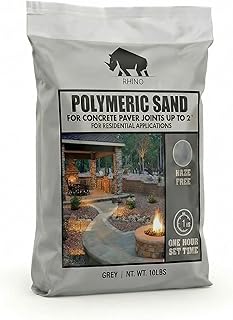
Best for: homeowners filling joints up to 2 inches in concrete or wet-cast pavers. This 10-pound slate-gray polymeric sand is described for patios, driveways, walkways, and areas around pools. Its stated purpose is to stabilize paver joints and help limit material passing through them.
The product is presented as designed to withstand rain, snow, and strong sunshine. Choose it when the joint width falls within its stated maximum and you want a sand intended for several common outdoor paving applications.
Limitation: The listed maximum joint width is 2 inches, so it is not the listed choice for wider gaps. Follow the package directions for surface preparation and activation.
DOMINATOR Polymeric Sand With Ceramic Flex

Best for: projects with joints between 1/8 and 4 inches, based on the listed product range. The 10-pound gray-beige sand features Ceramic Flex technology and a cement-free formula. The product description says it sweeps into joints and rinses easily, and the bag has an easy-pour handle.
This is the better fit when joint width is the main selection factor and the gap is wider than the stated limit for some other options. The color may also suit projects where a gray-beige joint finish is preferred.
Limitation: The listing says this sand does not replace grout, mortar, or paver edging. It should not be selected as a substitute for those materials or installation components.
Alliance Gator G2 Maxx Polymeric Sand

Best for: people working on patios, walkways, driveways, pool decks, or stone installations who want a 50-pound bag. The product is slate gray and described as a professional paver joint sand with rain-safe technology that sets quickly and resists washout after activation.
Its stated joint-stabilizing purpose makes it more directly relevant to paver stones than landscape binders or decorative sand. Choose this option when a larger bag suits the project and the application matches the listed uses.
Limitation: The supplied details do not state a joint-width range. Check the product packaging to confirm suitability for the specific paver gaps before purchase.
AlloyStory Rock Glue For Landscaping

Best for: stabilizing loose gravel, pebbles, mulch, or similar landscape materials in yards, paths, and patios. The 32-ounce product is a water-based binder described as water permeable and suitable for holding several organic and mineral materials in place.
This is a different type of product from polymeric sand. Consider it when the goal is to bind a loose decorative surface rather than fill conventional joints between installed pavers.
Limitation: The listing does not describe it as paver joint sand, and its stated drying time is weather-dependent at 12–24 hours. It is not a direct substitute for jointing sand in a typical paver installation.
Coarse Quartz Sand For Decorative Uses

Best for: decorative projects such as succulent or bonsai displays, vase filling, and aquarium decoration, according to the product name. It is a 5-pound coarse sand with 2–4 mm particles.
This product is included as a useful distinction for shoppers comparing sand listings: its stated applications are decorative and plant-related, not paver joint stabilization.
Limitation: The supplied information does not identify it as polymeric sand or as suitable for filling outdoor paver joints. Avoid choosing it for that purpose based on the listed details.
Buying Guide: How To Choose Sand For Paver Stones
Do you need joint sand or a landscape binder?
For gaps between installed pavers, start with a product specifically described as polymeric sand or paver joint sand. A rock glue or gravel binder serves a different role: it holds loose landscape materials together. Decorative quartz sand is also not equivalent to a joint-stabilizing product.
What joint width should the sand cover?
Measure the joint before selecting a product. Rhino lists a maximum width of 2 inches, while DOMINATOR lists a range of 1/8 to 4 inches. The Gator product details provided here do not specify a width range, so check its packaging for that information.
Which color and bag size make sense?
Compare the listed colors with the pavers and the appearance you want for the joints. Rhino is slate gray, DOMINATOR is gray beige, and Gator is slate gray. Bag sizes vary from 10 pounds for Rhino and DOMINATOR to 50 pounds for Gator; estimate project needs using the product instructions rather than assuming one bag size fits every layout.
How should polymeric sand be installed?
Use the directions supplied with the specific product. Joint preparation, sweeping, cleanup, and activation steps can affect the finished surface. Avoid applying a product as a replacement for grout, mortar, or edging when the manufacturer says it is not intended for those purposes.
Frequently Asked Questions
What kind of sand is best for paver joints?
Polymeric sand is the most relevant type among these options because it is specifically described for stabilizing paver joints. Choose a product whose stated joint range fits the gaps.
Can regular decorative sand be used between pavers?
The decorative quartz sand listed here is described for plant and display uses, not paver joints. The supplied product details do not establish it as suitable for that application.
Is rock glue the same as polymeric sand?
No. The rock glue is a binder for loose materials such as gravel, pebbles, and mulch. Polymeric sand is marketed for filling and stabilizing paver joints.
Which listed sand covers the widest stated joint range?
DOMINATOR lists joints from 1/8 to 4 inches. Rhino lists a maximum joint width of 2 inches.
Does rain-safe mean installation directions can be skipped?
No. Gator G2 Maxx is described as rain safe after activation, but users should still follow the product’s installation instructions.