Best Commercial Walk-Behind Salt Spreaders for Winter Maintenance
Winter maintenance demands reliable equipment that can evenly distribute ice melt, rock salt, or sand across large areas. For commercial crews and property managers, a walk-behind spreader offers maneuverability and durability without needing a vehicle. This guide highlights five top walk-behind and closely related spreaders suitable for heavy use in commercial settings. Each selection balances capacity, build quality, ease of use, and longevity. The accompanying table provides a quick comparison, helping readers evaluate hopper size, type, and core features at a glance. Read on to understand how these units perform under demanding winter conditions.
| Product | Brand | Hopper Capacity | Type | Notable Feature |
|---|---|---|---|---|
| SaltDogg WB155BG Walk-Behind Spreader | SnowDogg | 100 lb | Walk-Behind | Steel frame |
| EarthWay Polar Tech 65 Lb Walk-Behind | EarthWay | 65 lb | Walk-Behind | Rustproof poly hopper; 13″ tires |
| The Andersons Pacer Pro Walk-Behind | The Andersons | 80 lb | Walk-Behind | Spider agitator; hopper cover included |
| Brinly Deluxe Tow Behind Spreader | Brinly | 175 lb | Tow-Behind | Extended Easy-Reach Handle; weatherproof cover |
| SaltDogg SHPE1500 Electric Drive Spreader | SaltDogg | 0.75 cu yd | Bed-Mounted Electric Drive | Stainless auger; 14″ poly spinner; 12V DC drive |
SaltDogg WB155BG Walk-Behind Spreader
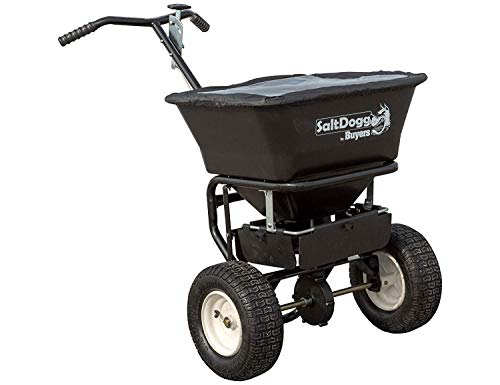
The SaltDogg WB155BG Walk-Behind Spreader from SnowDogg is designed for professional outdoor use with a 100-pound hopper and a robust steel frame. This model is positioned as a durable, portable option for commercial applications such as parking lots, sidewalks, and driveways that require frequent material dispersal. The walk-behind design enables precise control over application density and pattern, which is essential when treating high-traffic areas or irregular surfaces. The steel frame contributes to long-term durability in harsh winter conditions, helping workers reduce downtime due to equipment wear.
In operation, the WB155BG supports straightforward loading and steady flow of salt or ice melt. Although specific spread-range figures are not listed here, the unit’s capacity and sturdy construction suggest it can cover moderate to larger areas between refills with reliable consistency. For crews that prioritize rugged construction and predictable performance in a portable format, this model aligns with standard commercial expectations. Regular inspection of moving parts, rust protection on exposed metal, and proper hopper cleaning after seasons of use will help preserve reliability.
Overall, the WB155BG provides a practical balance of capacity and portability for walk-behind applications. It suits mid-sized commercial properties and service vendors that need a dependable, simple-to-use spreader without the complexity of a mounted or vehicle-based system.
EarthWay Polar Tech 65 Lb Walk-Behind Spreader

The EarthWay Polar Tech 65 Lb Walk-Behind Spreader is designed for steady, dependable performance in winter conditions. Its 65-pound hopper capacity is well-suited for frequent, mid-size applications across commercial properties. A rustproof poly hopper helps resist corrosion from salt and ice melt, contributing to a longer service life in harsh environments. The unit features 13-inch pneumatic tires that provide improved traction and better handling on slick pavement, reducing the risk of wheel slippage during application. An adjustable handle and solid linkage control enable operators to tailor the spread pattern and gate settings to varying material types.
Key design elements include the able-to-handle ice melt or rock salt with a controlled flow, thanks to the solid linkage that connects the operating handle to the gate. The tires’ larger diameter aids stability and rollover resistance on uneven surfaces, while the poly hopper keeps weight manageable for manual pushing and guiding. This model is a practical choice for maintenance crews who need a versatile, mid-capacity spreader that can handle regular rounds and thermal variability in winter weather.
For commercial users who value durability and ease of operation, the Polar Tech 65 Lb offers a balanced option between capacity and maneuverability. Its combination of a rustproof hopper, rugged tires, and adjustable handling makes it compatible with routine winter workloads on properties of moderate size and complexity.
The Andersons Pacer Pro Walk-Behind

The Andersons Pacer Pro Walk-Behind Spreader is positioned for professional-grade applications with an 80-pound hopper capacity. It is designed to deliver even and precise material distribution, which is critical for customers applying fertilizer, grass seed, or salt on larger lawns or commercial landscapes. A hopper cover is included, helping to protect the contents from precipitation and contamination during transport or storage. The spider agitator feature helps ensure consistent material flow, reducing the risk of clumping or incomplete coverage as the hopper empties.
From a maintenance perspective, the Pacer Pro emphasizes robust construction and straightforward serviceability. The combination of the hopper design and agitator helps maintain uniform spread patterns across varying material textures. The unit’s build is suitable for frequent seasonal use, particularly in properties where precise application rates matter for turf health and winter safety programs. Operators can expect steady performance with proper calibration and cleaning after heavy use, especially in salt-rich environments.
For commercial crews seeking a reliable, walk-behind option that prioritizes even distribution and user-friendly operation, the Pacer Pro provides a solid choice with proven performance in this segment of equipment.
Brinly Deluxe Tow-Behind Spreader

The Brinly BS361BH-A Deluxe Tow-Behind Spreader is a larger-capacity option designed for towing behind a tractor or ATV. It features a 175-pound hopper, a weatherproof cover, and an extended Easy-Reach Handle for convenient operation from the driver’s seat. Built with a rugged, rust-resistant poly hopper and stainless steel hardware, this model is suited to heavy seasonal workloads where larger quantities of seed, fertilizer, ice melt, or other materials must be dispersed over expansive areas. Its tow-behind configuration makes it ideal for properties that require wider coverage and where a vehicle is readily available for spreading duties.
Despite its convenience for larger properties, this model requires appropriate towing equipment and space for effective use. The extended handle helps with gate control and reduces operator fatigue during long spreading sessions. The unit’s durability is enhanced by the use of corrosion-resistant components, a critical consideration for winter tasks where corrosive materials are common. For property managers with tractors or ATVs and extensive outdoor areas, the Brinly Deluxe Tow-Behind offers a practical balance of capacity and versatility.
As a broader option within this guide, the Brinly model demonstrates how capacity and ease of use scale with vehicle-assisted spreading. It complements the walk-behind options by serving larger, vehicle-accessible sites where quicker, broader coverage is needed.
SaltDogg SHPE0750 Commercial Salt & Sand Spreader

The SaltDogg SHPE0750 is a compact commercial spreader sized for smaller utility vehicles and UTVs, with a 0.75 cubic yard hopper. It’s designed for salt and sand applications, featuring a high-flow chute and a stainless steel auger. The black, double-wall poly hopper is resistant to rust and dents, making it suitable for bulk material handling in challenging winter environments. It includes a 12V DC-powered electric drive for controlled material dispersement, and the design supports standard bed installations suitable for many light- to mid-duty commercial fleets.
For operators who need a reliable spreader that can handle typical commercial loads without requiring full-size trucks, the SHPE0750 presents a versatile option. It emphasizes ease of cleaning and storage, with a removable chute and straightforward maintenance paths. When selecting a spreader for a mixed repertoire of materials and weather scenarios, this model provides a practical balance of capacity and drive efficiency for medium-duty applications.
Buying Guide
Key purchase considerations
Selecting a commercial spreader depends on workload, site size, and vehicle availability. Start by assessing capacity needs: larger properties or frequent use often justify higher hopper volumes, while smaller sites may do well with mid-range options. Consider whether you will push the unit (walk-behind), tow it behind a vehicle, or mount it on a utility vehicle. Each configuration has trade-offs in maneuverability, coverage, and required infrastructure. Durability matters in winter environments, so evaluate hopper materials, frame construction, and corrosion resistance. Finally, review control features such as gate adjustment, agitator design, and drive mechanism to ensure consistent distribution.
Walk-behind vs tow-behind vs vehicle-mounted
Walk-behind spreaders offer precise control over application density and are ideal for patch treatments or irregular surfaces. They require physical effort but excel in tight spaces. Tow-behind models speed up coverage over large areas but demand suitable towing equipment and space. Vehicle-mounted spreaders provide the highest capacity and efficiency for expansive properties and frequent applications, but they come with higher upfront costs and vehicle compatibility considerations. Understanding the layout of your properties and the daily workflow will guide the best choice for reliable, repeatable results.
Capacity, materials and spread pattern
Capacity determines how often you must refill. For salt, ice melt, or sand usage, evaluate how often a hopper needs replenishment during a typical shift. Material type impacts wear; rust and abrasion resistance are important for salt-heavy environments. Spread pattern and range affect coverage and application accuracy—some units offer 30-foot spreads, while others focus on closer, more controlled distribution. If you work with blends (salt and sand, for example), ensure the unit can handle different textures without clogging or inconsistent flow.
Build quality and maintenance
Durability is critical for commercial use. Look for powder-coated steel or high-density poly hoppers, sealed gears or gearboxes, and weatherproof components. Regular cleaning after seasons of use helps prevent corrosion and material buildup. Check for easily replaceable parts, such as agitators, spinner assemblies, and gates. A hopper cover keeps moisture out and reduces clumping. Consider warranty terms and the availability of genuine replacement parts to minimize downtime during peak seasons.
Power, drive and operational considerations
Electric drives offer smooth, adjustable dispersion, especially for heavier loads. Manual gates rely on operator control and may require more attention during long jobs. When evaluating power, assess battery or electrical compatibility, cable routing, and ease of maintenance. For walk-behind units, ergonomic handle height and control placement influence comfort during extended use. For equipment used across varied terrains, traction-prone tires and frame balance contribute to stability and user safety.
Practical recommendations
- For frequent, mid-size commercial sites, prioritize walk-behind units with 60–100 lb capacities for a balance of maneuverability and refill frequency.
- For larger properties with vehicle access, consider tow-behind or bed-mounted spreaders with hopper capacities around 175 lb or more.
- Choose corrosion-resistant materials and a straightforward maintenance plan to maximize uptime during winter seasons.
- Match spreader type to fleet availability: if you rely on a vehicle, a bed-mounted or tow-behind option may deliver faster coverage.
- Ensure the spreader’s pattern and span align with typical treatment areas to achieve even distribution without overspreading.