Best Equipment for Milking Cows: Essential Tools for Efficient Dairy Days
Direct answer: This guide highlights key milking equipment suited for different dairy setups, from hands-off farms to small homesteads. The top picks cover automatic milking machines, liners, manual pumps, and cow-safety aids to improve efficiency and animal comfort. Best for commercial dairies: robust electric milking systems. Best for hobby farms: portable manual kits. Best for safety-conscious operators: kick restraints and milking stands. Below, find concise buying guidance and five carefully chosen products with clear usage scenarios.
| Product | Best For | Key Benefit |
|---|---|---|
| VEVOR Electric Cow Milking Machine | Medium to large dairy operations | Fast milking with adjustable vacuum and mobility |
| KINGTAIXIN Black Soft Rubber Milking Liner Replacement | Farm maintenance & hygiene | Leakproof, quick to install, food-grade materials |
| YARNOW Manual Goat Milking Machine | Small farms, hobbyists | Portable, silent operation, precise 1L bottle |
| USUNFARM 1PC Cattle Stop Kick Rod | Cattle safety and handling | Adjustable anti-kick device for safer milking |
| KIPPDURO 14L Electric Milking Machine | Outdoor milking and off-grid setups | Large capacity, rechargeable, pulsation control |
VEVOR Electric Cow Milking Machine
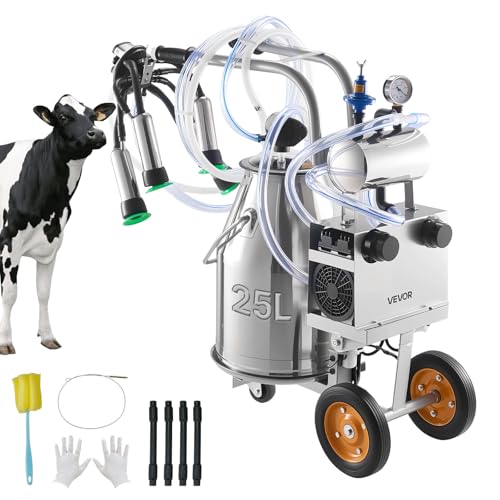
The VEVOR model combines a 750W vacuum pump with strong, stable suction and adjustable 45–50 kPa vacuum. It features biomimetic pulsation for animal comfort and thickened stainless steel teat cups that fit securely. Best for farms seeking faster milking and consistent performance. Choose this if you operate a mid-sized dairy and need reliable automation with mobility. A caution: regular cleaning is essential to maintain suction efficiency and hygiene.
KINGTAIXIN Black Soft Rubber Milking Liner Replacement

These 4PCS milking liners provide a leakproof connection with steel cups, ensuring efficient milking sessions. The liners are soft silicone, food-grade, and easy to install or replace, supporting hygienic milk production. Best for dairies needing simple maintenance and reliable liners. Pick this if you want quick, hygienic liner changes without specialized tools. Limitation: compatibility depends on your existing teat cups and cups’ dimensions.
YARNOW Manual Goat Milking Machine

Designed for small farms and hobbyists, this manual setup uses an ergonomic hand pump to reduce fatigue. It provides gentle suction with a soft silicone teat cup and a 1L clear bottle for real-time milk monitoring. Best for beginners or elderly users seeking a quiet, off-grid option. Choose this if you mainly milk a few animals and want a low-cost, low-maintenance solution. Limitation: manual operation requires hand effort and may be slower than electric models.
USUNFARM 1PC Cattle Stop Kick Rod

Adjustable stainless steel anti-kick device with rubber pads, designed to reduce kicking during handling and milking. Best for farms needing added safety during milking and restraint. Choose this if kicking has caused handling challenges. Limitation: may require proper sizing and training to fit different cow sizes securely.
KIPPDURO 14L Electric Milking Machine

Featuring a large 14L stainless steel bucket and adjustable vacuum/pulsation (32–46 times per minute), this unit is suited for higher throughput on small farms or mobile dairy setups. It is rechargeable for off-grid use, aiding operations away from constant power. Best for farmers needing portability and higher milk output. Caution: battery life and charging time can affect continuous milking sessions on busy days.
Buying Guide: Key Considerations For Milking Equipment
What type of milking operation do you run? Choose equipment that matches your herd size, milking frequency, and power availability. Electric systems are ideal for larger herds; manual options suit small farms or off-grid sites. Portability matters for farms moving between paddocks or doing outdoor milking.
How important is animal comfort and milk hygiene? Look for soft silicone liners and hygienic, food-grade materials. A biomimetic pulsation system and leakproof liners reduce udder stress and milk contamination risks. Regular cleaning protocols are essential for all systems.
What storage capacity do you need? Larger buckets (like 14L) reduce refill frequency on busy days but require more space. Smaller kits work well for hobby farms or occasional milking.
What are the safety considerations? Anti-kick devices and sturdy stands improve operator safety during milking. Ensure proper fit and training for any restraint tools to avoid injury to animals or handlers.
What about maintenance and parts availability? Favor products with readily available liners, hoses, and replacement parts. Easy installation and routine cleaning features save time and keep systems functioning smoothly.
FAQ
- Which milking setup is best for a small farm? A manual or compact electric system with easy-clean liners and a small-capacity bucket is typically simplest and most affordable.
- How often should I replace milking liners? Replace liners when they show wear, cracking, or loss of pliability. Regular maintenance reduces milking stress and leakage.
- Is a rechargeable milker suitable for off-grid farms? Yes, portable rechargeable units are designed for off-grid use, enabling milking without constant power access.
- What safety tools help during milking? Anti-kick devices, sturdy stands, and proper handling procedures help protect both cows and handlers.
- Can I mix products from different brands? Yes, but ensure compatibility with your existing cups, hoses, and fittings to avoid leaks or poor suction.
- What should I consider for hygiene? Look for food-grade materials, easy-to-clean components, and clear monitoring bottles for real-time milk checks.