Best Fungicidal Sprays for Plants: Five Options for Garden Disease Control
The best fungicidal spray for plants depends on the disease, the crop, and whether you also need insect control. Bonide Captain Jack’s Copper Fungicide is a straightforward ready-to-use copper option; Bonide Neem Oil and Garden Safe Fungicide3 combine fungicide and pest-control uses; Grower’s Ally is aimed at powdery mildew and mold; and Neudorff Copper Soap lists uses across vegetables, fruit, roses, and ornamentals. Compare the product label with your plant and disease before applying.
| Product | Best suited for | Notable distinction |
|---|---|---|
| Bonide Captain Jack’s Copper Fungicide | Ready-to-use copper spray | For all plants, according to the product name |
| Bonide Captain Jack’s Neem Oil | Gardeners seeking multiple uses | Fungicide, insecticide, and miticide |
| Grower’s Ally Fungicide | Powdery mildew and mold concerns | Food-grade formula; listing details need checking |
| Garden Safe Fungicide3 | Fungal disease and insect management | Neem-oil formula with three stated uses |
| Neudorff Copper Soap Fungicide | Vegetables, fruits, flowers, and ornamentals | Lists several plant diseases and crop types |
Bonide Captain Jack’s Copper Fungicide
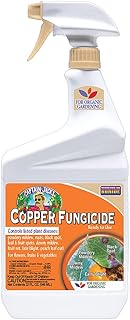
This 32-ounce ready-to-use spray is best for gardeners who want a copper fungicide without mixing a concentrate. The product name describes it as suitable for all plants and for organic gardening, and says it controls common diseases. Those broad descriptions make it a practical option to compare when choosing a general-purpose spray.
Choose this if ready-to-use packaging is a priority. Before applying, check the product label for the specific disease, plant, application frequency, and precautions. The supplied product information does not identify particular diseases, so it is not possible to confirm from that information alone whether it covers a specific problem.
Bonide Captain Jack’s Neem Oil

Bonide Captain Jack’s Neem Oil is best for gardeners who want one ready-to-use product described as a fungicide, insecticide, and miticide. The 32-ounce spray is presented for plants and organic gardening. Its multiple stated purposes may suit gardens where fungal disease and pests are both concerns.
Choose this if you want neem oil and broader garden-use purposes in one spray. Do not assume it controls every plant disease or pest: consult the label to confirm the specific target and approved plant. The product information provided does not name individual diseases or application directions.
Grower’s Ally Fungicide Concentrate
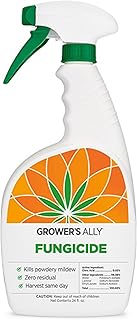
Grower’s Ally is best for shoppers focused on powdery mildew and mold. The listing describes a 24-ounce food-grade formula for indoor or outdoor use and states that it is OMRI listed and safe for harvest day and pets. These are listing claims; follow the current product label for use conditions and handling.
There is a labeling detail to resolve before purchase: the product name calls it a concentrate, while the listing text also describes it as a ready-to-use spray. Check the container directions to determine whether mixing is required. This option is less suitable if you need a product whose application format is clear from the supplied information.
Garden Safe Fungicide3 With Neem Oil

Garden Safe Fungicide3 is best for gardeners seeking combined fungal disease and insect-management uses. Its listed active ingredient is clarified hydrophobic extract of neem oil. The product description says it controls black spot, rust, powdery mildew, and other listed fungal diseases, and describes insect control across egg, larval, and adult stages.
Choose this if the listed disease targets match your plant problem and you also want insecticide and miticide uses. The phrase “other listed” makes the label important: confirm that the exact disease and plant are included. Avoid relying on the broad three-in-one description as proof that it treats an unlisted problem.
Neudorff Copper Soap Fungicide
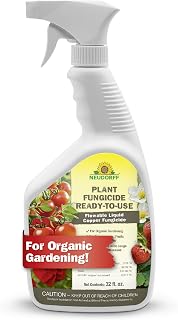
Neudorff Copper Soap is best for gardeners looking for a ready-to-use copper spray with several named disease targets. Its listing includes powdery mildew, rust, black spot, leaf and fruit spot, downy mildew, fruit rot, late blight, and peach leaf curl. It names roses, vegetables, fruits, fruit trees, flowers, and ornamentals as intended plant types.
The listing also describes indoor houseplant use and use up to harvest day. Check the label for the exact crop, disease, and timing before spraying. This product may be a better match than a broadly described fungicide when the listed disease and plant fit, but it should not be treated as a universal remedy.
Buying Guide: How To Choose A Plant Fungicide
Which disease are you treating?
Start by identifying the symptoms and, when possible, the disease. Powdery mildew, rust, black spot, and blight are not interchangeable targets. Compare the disease name on the product label with the problem affecting your plant. A spray’s general fungicide description does not establish that it treats every fungal disease.
Do you prefer ready-to-use spray or concentrate?
Ready-to-use products avoid a separate mixing step. Concentrates may require measuring and dilution, so follow the label precisely. The Grower’s Ally listing uses both “concentrate” and “ready to use” language; verify its directions before deciding. Do not infer mixing requirements from the container size alone.
Does the label cover your plant and harvest timing?
Check whether the product is labeled for the specific vegetable, fruit, flower, tree, or houseplant. For edible crops, confirm application timing and any harvest directions on the label. Also read precautions for people, pets, beneficial insects, and nearby plants; do not rely on a product title as a substitute for instructions.
Would a multi-purpose formula help?
Neem-oil products in this list are described as having fungicide and insect-control purposes. That may be useful when both issues are present, but it does not mean one application controls every pest and disease. A copper product may be a more direct comparison when you are selecting a fungicide and the listed crop and disease fit.
Frequently Asked Questions
What is the best fungicidal spray for plants?
There is no single best spray for every plant. Choose a product whose label names both the affected plant and the disease you are treating.
Can neem oil be used as a plant fungicide?
The Bonide Captain Jack’s Neem Oil and Garden Safe Fungicide3 listings describe neem-oil products with fungicide uses. Confirm the disease and plant on the product label before use.
Can I use copper fungicide on vegetables?
Neudorff lists vegetables among its intended uses. Check its label for the specific crop, disease, and application timing before spraying.
Should I spray a plant as soon as I see spots?
First identify the likely cause. Spots can have causes other than fungal disease, and a fungicide may not address those problems. Match the diagnosis to the label.
Are these products safe for edible plants?
Some listings describe use on fruits or vegetables, and Grower’s Ally mentions harvest-day use. Confirm crop-specific directions and harvest instructions on the product label before applying.