Best Fungicides for Cherry Trees: Five Options and How to Choose
The best fungicide for a cherry tree depends on the disease, the tree’s growth stage, and whether the product label permits use on cherries. Bonide Fruit Tree & Plant Guard is the most directly positioned for fruit trees, while the copper products offer organic-gardening options. Earth’s Ally lists use on fruits and trees. Always confirm the exact crop, disease, timing, and harvest restrictions on the current label before applying.
| Product | Best suited for | Key distinction |
|---|---|---|
| Bonide Fruit Tree & Plant Guard | Fruit-tree growers seeking broader pest coverage | Fungicide plus several other control functions |
| Bonide Captain Jack’s Copper, Ready-to-Use | Convenient organic-gardening use | Pre-mixed spray |
| Bonide Captain Jack Copper Concentrate | Organic gardeners who prefer concentrate | Mix according to label directions |
| Earth’s Ally Disease Control | Growers looking for a fruit-and-tree-listed option | Citric acid formula |
| Atticus Gravex 20EW | Buyers considering a targeted fungicide ingredient | Myclobutanil concentrate; verify cherry use |
Bonide Fruit Tree & Plant Guard

This 32-ounce concentrate is the most directly relevant choice in this group for a cherry-tree grower because its listed uses include fruits, nuts, vegetables, ornamental shrubs, trees, and flowers. The product combines fungicide, insecticide, miticide, aphicide, and scalicide functions, so it may suit someone addressing more than one kind of garden pest.
Best for: Home orchard owners looking for a multi-purpose product labeled for fruit trees. Why it was selected: Its stated fruit and tree uses make it a closer fit than products described mainly for ornamentals or general garden plants. Caution: The supplied product information does not name cherries or specific fungal diseases. Check the label for cherry-tree approval, target disease, application timing, and harvest interval.
Bonide Captain Jack’s Copper Ready-to-Use
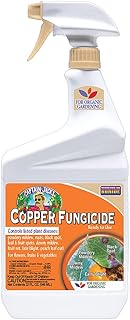
This 32-ounce ready-to-use copper spray is designed for gardeners who want a pre-mixed product rather than a concentrate. Its listed disease targets include blight, black spot, powdery mildew, and peach leaf curl. The product is described as approved for organic gardening and suitable for use up until harvest, subject to label directions.
Best for: Gardeners who prefer a ready-to-spray format and organic-gardening compatibility. Why it was selected: It offers a straightforward application format and lists several common diseases. Caution: The feature list does not specifically confirm use on cherries or list every cherry disease. Verify both on the label before spraying; organic positioning does not replace label precautions.
Bonide Captain Jack Copper Concentrate

This 16-ounce concentrate offers the copper fungicide approach in a format intended to be diluted according to its directions. The listed features describe control and prevention of several plant diseases, including blight, black spot, powdery mildew, and peach leaf curl. It is also described as approved for organic gardening.
Best for: Organic gardeners who want a concentrate rather than a pre-mixed spray. Why it was selected: It shares the ready-to-use version’s broad listed disease examples while giving buyers a different format to consider. Caution: The product information does not establish a cherry-specific use or mixing rate. Follow the label for approved crops, dilution, protective measures, and any application limits.
Earth’s Ally Disease Control Concentrate

Earth’s Ally lists use on fruits, vegetables, trees, shrubs, flowers, and ornamentals. Its disease-control claims include powdery mildew, downy mildew, blight, canker, black spot, and leaf spot. The concentrate is formulated with citric acid and is presented as a product that treats and helps prevent common plant diseases.
Best for: Growers seeking a citric-acid-based option with fruits and trees among its listed plant types. Why it was selected: Those stated uses are relevant to orchard and landscape settings. Caution: The supplied features do not specifically name cherry trees or identify which diseases are controlled on cherries. Confirm the exact crop and disease on the current product label.
Atticus Gravex 20EW Myclobutanil

Gravex 20EW is a 16-ounce concentrate containing 19.7% myclobutanil. Its listed features describe curative and preventive action and name more than 38 plant fungi, including powdery mildew, scab, and black spot. The examples also include several turf diseases, so its broad claims should not be treated as confirmation of cherry-tree use.
Best for: Buyers comparing myclobutanil products who will verify crop-specific directions before use. Why it was selected: It offers a different active ingredient from the copper options. Caution: The supplied details do not specify cherry trees or fruit-crop directions. Do not apply to an edible crop unless the label expressly permits it and provides directions for that use.
Buying Guide: Choosing A Fungicide For Cherry Trees
Which disease are you trying to control?
Identify the problem before choosing a product. Cherry trees can show symptoms caused by disease, insects, weather, or other stress. Compare visible signs with reliable local guidance, and select a product only when its label lists the target disease and cherry trees or the relevant fruit crop.
Does the label allow use on cherries?
Check the product label for the crop, disease, application site, and timing. A product listing that mentions fruits, trees, or a disease generally does not prove that it is approved for every fruit tree. Follow the label’s mixing, application, protective-equipment, and harvest instructions.
Should you choose ready-to-use or concentrate?
Ready-to-use sprays avoid measuring and mixing, while concentrates require preparation according to label directions. Choose based on the area to treat and your ability to apply the specified dilution accurately. Do not assume that products with similar names have identical directions.
What else should you compare?
- Whether the product is labeled for the specific cherry disease.
- Whether it can be used at the tree’s current growth stage.
- Restrictions on repeat applications, weather, and harvest timing.
- Whether the formula addresses fungal disease alone or also lists insect control.
Frequently Asked Questions
Can I use copper fungicide on a cherry tree?
Only if the product label permits use on cherries or the applicable fruit crop and provides directions for the target disease. The listed copper products name several diseases but do not explicitly identify cherries in the supplied features.
Which option is most directly aimed at fruit trees?
Bonide Fruit Tree & Plant Guard lists fruits and trees among its intended uses. Confirm that cherries and the specific disease are covered on its label.
Is ready-to-use spray better than concentrate?
Neither format is universally better. Ready-to-use spray is pre-mixed; concentrate requires label-directed dilution. Choose the format you can apply accurately and safely.
Can I spray fungicide close to harvest?
Follow the product’s harvest interval and all label restrictions. Do not rely on a general claim about use timing when the directions for the specific crop may differ.