Best Granular Weed Killers for Large Areas: Effective Long-Lasting Control
Maintaining large outdoor spaces requires reliable weed control that covers broad areas efficiently. Granular weed killers offer scalable application, long-lasting effects, and easier coverage for expansive sites such as commercial landscapes, railroad rights‑of‑way, and large lawns. This guide presents five well‑regarded products that balance performance, safety, and convenience for large‑area use. Each entry includes a concise product overview and a practical usage note. A short buying guide follows to help compare formulations, coverage, and residual performance so you can choose the right option for your property.
| Product | Brand | Size / Coverage | Primary Use | Notable Benefit |
|---|---|---|---|---|
| Spra Kil SK-26 Granular Weed Killer | SpraKil SK-26 | 40 lb Pail | Non-cropland areas | Soil sterilant with broad-spectrum control |
| BioAdvanced Season Long Lawn Weed Killer Plus Preventer | BioAdvanced | 10 lb Granules / 4,000 sq ft | Southern lawns | Kills and prevents weeds up to 6 months |
| Spectracide Weed Killer, 10.8 lb | Spectracide | 10.8 lb | Lawn weed control | Will not harm lawns when used as directed; up to 5 months control |
| The Andersons Barricade Granular Pre-Emergent | The Andersons | 18 lb | Pre-emergent weed prevention | Prevents a broad spectrum of grasses and broadleaf weeds |
| RM43 Concentrated Extended Control Weed Killer | RM43 | Concentrated — mix with water | General weed control | Up to one year of control after application |
SpraKil SK-26 Granular Weed Killer

SpraKil SK-26 is a granular, nonselective herbicide formulated for broad weed and grass control in noncrop areas. The product lists tebuthiuron (2.0%) and diuron (6.0%) as active ingredients, with 92% other ingredients, totaling 100%. It is designed for non-cropland sites such as railroad rights‑of‑way and industrial areas, where vegetation management is needed over large, uncropable spaces. The label explicitly states not to use on cropland or land intended for future crops. This formulation provides rapid, broad-spectrum activity and residual effects suitable for mechanical clearance and site maintenance. Careful placement is essential to protect nearby desirable vegetation and waterways.
For large properties, the 40‑pound pail supports extended coverage with fewer refill trips. Because this product is nonselective, it will affect most weeds and grasses it contacts. It is best applied with appropriate spreader equipment to ensure uniform distribution across pavement shoulders, ditch lines, and drainage areas. Always follow label guidance for safety gear, application timing, and buffer zones to minimize drift and environmental impact. This product is most appropriate for permanent non-crop landscapes where soil sterilant action is acceptable and future planting is not planned.
BioAdvanced Season Long Lawn Weed Killer Plus Preventer

BioAdvanced Season Long Lawn Weed Killer Plus Preventer comes in granules formulated for southern turf. It targets broadleaf weeds with a residual herbicide designed to prevent recurrence for up to six months. The product specifically notes effectiveness on southern lawn varieties and coverage of 4,000 square feet, including St. Augustinegrass and Floratam. The combination of active weed killers and residual control makes it a practical choice for large lawn areas where seasonal weed pressure is predictable, such as warm-season turf regions. It is designed to be applied periodically during the growing season to maintain weed suppression.
The product’s prevention component helps reduce re‑infestation by blocking weed establishment after initial kill. For managers maintaining expansive Southern lawns, this product offers a straightforward application regime with clear seasonal timing. Because it is granular, ensure even distribution with a broadcast spreader and water in as required by the label. As always, observe safety guidelines, especially around pets and children, and avoid contact with ornamental plantings that may be sensitive to herbicides.
Spectracide Weed Killer, 10.8 lb, Clear
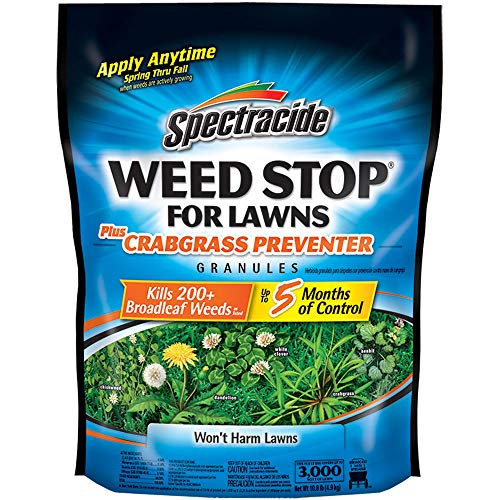
Spectracide Weed Killer in the 10.8‑lb Clear formulation is described as safe for lawns when used as directed and capable of killing more than 200 types of weeds. It includes a pre-emergent crabgrass component, offering preventative control for annual grasses in addition to post‑emergence weed killing. The product emphasizes up to five months of control when applied according to label directions and recommends application with a spreader for even coverage. This makes it a practical option for homeowners and managers seeking a broad spectrum treatment with an emphasis on lawn safety.
When used as part of a routine seasonal program, this product helps manage both current weed populations and anticipated arrivals. It can be applied across large lawn areas or along driveways and walkways to prevent weed encroachment. As with all herbicides, correct timing, rate, and weather conditions are essential to maximize efficacy and minimize unintended turf injury. Follow the label carefully to ensure compatibility with your turf type and landscape conditions.
The Andersons Barricade Professional-Grade Granular Pre-Emergent

The Andersons Barricade is a professional‑grade granular pre-emergent weed control product designed to prevent germination of grassy and broadleaf weeds. It contains 0.48% prodiamine as its active ingredient and is intended for early spring and fall applications. The product is focused on prevention rather than eradicating existing weeds, making it ideal for site preparation and ongoing weed management in lawns, landscapes, and other non-crop areas. Coverage is substantial, with the 18‑lb bag designed to protect approximately 5,800 square feet per application when used as directed.
Because Barricade acts as a preventive measure, timing is critical. Apply before weeds germinate for best results, and follow the label for rate guidelines, re‑entry intervals, and compatibility with other turf management practices. The granular form lends itself to uniform distribution with broadcast spreaders across larger sites, minimizing gaps and reducing future weed establishment. This product is a strong option for property managers prioritizing long‑term weed prevention rather than post‑emergence control alone.
RM43 Concentrated Extended Control Weed Killer
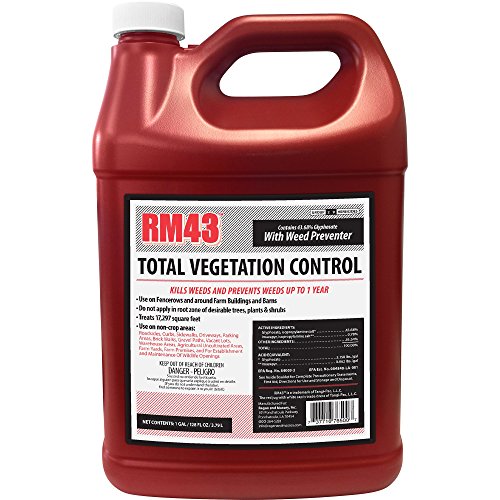
RM43 is a concentrated weed killer designed for mixing with water and applying via sprayer. The formulation emphasizes extended control, with claims of up to one year of weed suppression. This product is suitable for larger landscapes and settings where a spray application can reach expansive areas, such as parking lots, driveways, right‑of‑ways, and large turf or mulch beds. Because it is a concentrate, it requires proper dilution, calibrated sprayer equipment, and adherence to label instructions to achieve uniform coverage and avoid off‑target damage.
For sites where year‑long weed suppression is desired, RM43 provides a robust option. Its effectiveness depends on thorough mixing, nozzle selection, and environmental conditions at application. As with all concentrated systems, users should plan for multiple applications across seasons if needed, and always follow the label for safety, protective gear, and environmental precautions. This option is best for capable crews managing sizable landscapes with spray equipment on hand.
Buying Guide
When choosing a granular weed killer for large areas, consider the site type, weed spectrum, and the desired duration of control. Granular formulations are generally favored for bulk coverage because they can be distributed evenly with broadcast spreaders, reducing application time versus liquids over extensive spaces. However, they require careful calibration to avoid drift or contact with desirable plants if near landscaped areas. For sites like railroad rights‑of‑way or industrial lots, soil‑active products can offer lasting suppression, while lawn-focused products emphasize safety for turf and human activity.
- Site Type and Target Weeds: Identify whether the primary goal is preventing germination (pre‑emergent) or eradicating existing weeds (post‑emergence). Choose products whose label matches your weed spectrum (broadleaf, grasses, crabgrass, etc.).
- Formulation and Application Method: Granular products work well with broadcast spreaders for wide areas; liquids or concentrates may be better for edges, borders, or irregular terrain. Ensure compatibility with your equipment and the site’s accessibility.
- Coverage and Bag Size: Compare square-foot coverage per bag or per acre and factor in re‑entry times, application frequency, and labor costs. Larger bags reduce refill needs on big sites.
- Residual Duration: Plan the treatment schedule around the desired period of suppression. Some products offer months of control; others promise up to a year. Align duration with weed pressure and growing season.
- Safety and Label Compliance: Always read the label for restricted use areas, buffer zones, water proximity, and re‑entry intervals. Consider pets, children, and nearby ornamentals when selecting a product.
- Weather and Timing: Apply under appropriate weather conditions to maximize effectiveness and minimize runoff or drift. Avoid applications just before heavy rain, extreme heat, or cold snaps that reduce product performance.
- Environmental Impact: Some products may affect non-target plants or sensitive ecosystems. Use soils and sites where the label indicates safety, and keep waterways protected with proper containment practices.
Quick comparisons: Granular vs Liquid/Concentrate
| Aspect | Granular | Liquid/Concentrate |
|---|---|---|
| Best Use Case | Large, uniform coverage with spreaders | Spot treatments, borders, and adjustable rates |
| Ease of Application | High with proper equipment | Requires sprayer and calibration |
| Residual Control | Often months to year months | Depends on dilution and label |
| Site Suitability | Noncrop areas and lawns | Lawn edges, cracks, and non-target areas |
| Safety Considerations | Watch drainage and runoff | Spray drift and inhalation risks |