Best Indoor Seed Starting Lights for Every Growing Setup
The best indoor seed starting lights provide seedlings with consistent light and a setup that fits your growing space. The Patigrow kit is best for beginners who want lights, trays, and self-watering in one system; Epic Gardening offers an integrated tray and full-spectrum light; FECiDA suits plant shelves; Barrina’s compact T5 fixtures fit smaller areas; and bseah provides adjustable brightness and an automatic timer.
| Product | Best For | Standout Feature |
|---|---|---|
| Patigrow 80-Cell Kit | Complete seed-starting setup | Self-watering tray and grow lights |
| Epic Gardening Grow Light | Organized seedling trays | Integrated watertight tray |
| FECiDA Flat Panels | Plant shelves | Linkable panels and timer |
| Barrina T5 1-Foot Lights | Compact growing areas | Separately controlled fixtures |
| bseah Grow Light | Adjustable light schedules | Dimming and daily timer |
Patigrow 80-Cell Self-Watering Seed Starter Kit

Best for: Beginners who want a combined tray, light, and watering setup. The kit includes an 80-cell seed-starting tray, grow lights, and a humidity dome. Its lighting has adjustable brightness and timer functions, so users can change settings for different plant stages.
The self-watering system is designed to maintain moisture while reducing the chance of overwatering or drying out. The manufacturer describes the dome and base as thick, BPA-free PET material. This product was selected because it combines seed-starting components that otherwise may need to be purchased separately.
Limitation: Its 80-cell format is specific to the included tray system, so it may be less suitable for growers who already have a different tray setup.
Epic Gardening Full-Spectrum Seed Starting Light

Best for: Gardeners who want a dedicated light with a built-in watering tray. Its integrated watertight tray can hold up to twelve 6-cell trays or eight 4-cell trays, helping keep watering contained. The full-spectrum LEDs are designed for seedlings, and the unit includes a timer.
The product uses 40 watts and is listed with up to 25,000 hours of continuous light. It was selected for growers who prioritize a tidy, organized setup and want to place multiple smaller seed trays beneath one light.
Limitation: Tray capacity is defined by the listed 4-cell and 6-cell tray formats; check your trays’ dimensions and arrangement before choosing this system.
FECiDA Flat Panel Grow Lights for Shelves

Best for: Seed starters using plant shelves who want multiple panels. The four-pack includes flat panels with 192 LEDs and 12 watts of actual power per panel, according to the product details. Series and parallel connection options allow the panels to be linked for a shelf setup.
The five-mode timer supports 4-, 8-, 12-, 16-, and 20-hour settings, with the two longer options created by combining buttons. These features make this a useful choice when consistent daily lighting and a less tangled multi-panel arrangement matter.
Limitation: The timer’s 16- and 20-hour modes require button combinations, so setting those schedules is less direct than selecting a single button.
Barrina T5 1-Foot Grow Lights

Best for: Growers who need compact fixtures and independent light control. This four-pack provides 1-foot T5 lights with 5000K white full-spectrum lighting. Each fixture has an on/off switch, allowing lights to be controlled separately or together according to plant needs.
The listed combined output uses 20 watts and 96 LEDs. Barrina describes the lights as suitable for seedlings as well as vegetative and flowering stages. The short fixture length makes this option worth considering for smaller growing areas where a longer light may not fit.
Limitation: Each fixture is only one foot long, so check whether that length provides the coverage needed for your tray or growing surface.
bseah Dimmable Grow Light With Timer
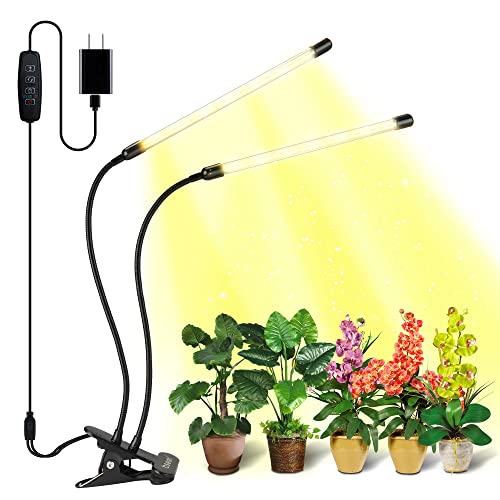
Best for: Seed starters who want adjustable brightness and a recurring daily schedule. The light offers 10 dimmable levels, three switch modes, and a timer with 3-, 9-, or 12-hour settings. Its full-spectrum LED combines yellow and white light, and the timer is designed to repeat daily when power remains connected.
This option was selected for its range of brightness and schedule settings, which give users choices as seedlings grow. It can also suit someone who wants automatic on/off operation rather than remembering to switch a light manually.
Limitation: The listed timer choices are limited to 3, 9, or 12 hours; choose another option if your planned schedule requires a different duration.
Buying Guide: How to Choose Indoor Seed Starting Lights
What kind of setup do you need?
Start with the growing area. A complete kit such as Patigrow combines trays, a humidity dome, lighting, and self-watering. An integrated-tray design like Epic Gardening can help keep watering organized. For existing shelves, linkable flat panels may be easier to arrange than a standalone kit. Compact fixtures can suit smaller surfaces, but measure the area they need to cover.
Should you choose a timer or manual controls?
A timer can make a repeated daily schedule easier to maintain. Compare the available durations before buying: the bseah model lists 3-, 9-, and 12-hour settings, while FECiDA lists five modes from 4 to 20 hours. Barrina’s listed feature is individual on/off control rather than an automatic timer.
How important is adjustable brightness?
Dimming is useful when you want to change light intensity without replacing the fixture. Patigrow and bseah list adjustable brightness. Other products emphasize their fixture format, panel connections, or integrated tray instead. Compare the control features that match your routine rather than assuming every grow light offers the same adjustments.
What should you check before ordering?
Confirm the number and dimensions of trays or panels, the fixture length, and whether the product includes the components you need. Check timer durations and connection options against your planned arrangement. Product listings describe different features, so do not assume that a light includes trays, a stand, or automatic scheduling unless the listing says so.
Frequently Asked Questions
Are full-spectrum lights suitable for starting seeds?
Several products here list full-spectrum lighting for seedlings or seed starting. Compare the product’s stated use and its coverage or fixture format with your setup.
Do indoor seed starting lights need a timer?
A timer is helpful for repeating a daily schedule. It is optional, but choose a model with timer durations that match your intended routine.
Can one grow light cover multiple seed trays?
Coverage depends on the fixture and arrangement. Epic Gardening lists capacity for specific tray formats; check dimensions and the product details before placing multiple trays under one light.
Are seed-starting kits better than lights alone?
A kit may be more convenient if you need trays and moisture management as well as lighting. A light-only product may suit growers who already own trays and want to build around their existing setup.