Best Mechanical Hose Faucet Timers for Easy Lawn and Garden Watering
Answering the question of which mechanical hose faucet timer fits best in your yard, this guide highlights durable, battery-free options ideal for hands-on gardeners who want reliable irrigation without electronics. These timers are best for homeowners who prefer simple, low-maintenance controls, occasional travelers, and anyone who wants predictable watering in varying weather. The top picks favor models with robust construction, straightforward dials, and clear indicators. Use the quick comparison table below to compare the five best mechanical timers and their core strengths.
| Product | Best For | Key Feature |
|---|---|---|
| Orbit Mechanical Water Timer – 62034 | Gardeners seeking battery-free reliability | Clockwork shutoff with easy-grip dial |
| Orbit 62041 Watering Timer | Those needing higher flow and metal build | 20% higher water flow; metal construction |
| Chapin 41004 Mechanical Timer | Standard hose setups with debris protection | Built-in filter; simple 15–120 minute range |
| Melnor 65136AMZ Mechanical Timer | Low-maintenance auto-off with manual option | Automatic shutoff; manual on/off |
| Ortis Hose Faucet Timer | Programmable schedules with versatile modes | Three modes; durable, leak-resistant design |
Overview: The following five mechanical timers cover a range of needs—from battery-free reliability to higher flow and adjustable programs. All are designed to help you water efficiently, even when you’re away, while keeping maintenance minimal and installation straightforward.
Orbit Mechanical Water Timer – 62034

The Orbit 62034 uses a clockwork shutoff mechanism with a battery-free operation, providing dependable irrigation control without electronics. The oversized dial offers smooth adjustments, and the interface remains easy to operate even with wet or gloved hands. Best for gardeners who want a simple, low-tech timer that reliably waters for a set period each session. A potential limitation is that its mechanical design may be less precise for very short watering intervals compared with digital timers, though it remains highly dependable for standard garden routines.
Orbit 62041 Watering Timer
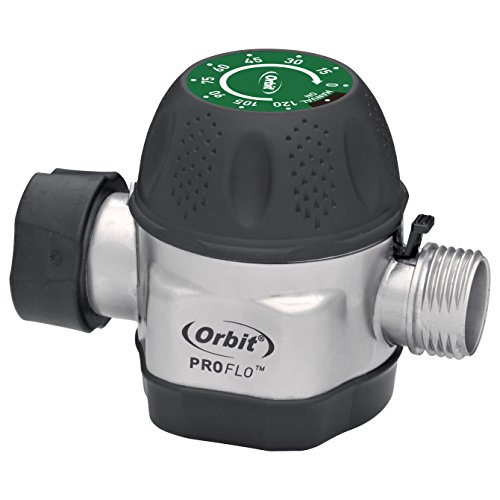
The Orbit 62041 emphasizes high flow with a metal construction, promising durability and long-term use. It’s ideal for gardeners who need more water throughput and a sturdy unit for frequent lawn or garden routines. The timer supports a 15 to 120-minute watering window, which helps tailor short, frequent cycles or longer soakings. Choose this if you prioritize rugged materials and better water delivery, but be aware a heavier metal unit may be less convenient for very lightweight hose setups.
Chapin 41004 Mechanical Timer

Chapin’s 41004 is designed for standard outdoor faucets with a filter at the tap to catch debris before reaching the timer. It features a manual dial and clear numbers, allowing for 15 to 120 minutes of watering. It works well with sprinklers and drip lines and is compatible with Chapin hose connectors. This timer is better for users who want built-in debris protection and a familiar dial layout, but it may require more attention to keep the filter clean in dusty environments.
Melnor 65136AMZ Mechanical Timer

The Melnor 65136AMZ provides automatic on/off watering with a manual override. It works with various sprinkler types, including low-pressure drip and soaker hoses, making it a versatile choice for different yard layouts. The timer is best for gardeners who want straightforward automation with an easy switch to manual use when needed. A potential limitation is that, as a mechanical timer, ultra-short run times may be less precise than digital counterparts.
Ortis Hose Faucet Timer

Ortis presents a programmable unit with three distinct modes: Auto, Manual, and Rain Delay. Its LCD display offers quick visibility of schedule details, run times from 1 to 300 minutes, and adjustable frequencies. The timer is designed to withstand weather exposure with a nylon-fiber composite valve body and a stainless steel core bracket, supporting up to 150 PSI. This mode-rich timer is best for gardeners who want flexible scheduling and rain delay features, but the advanced options may take longer to learn for first-time users.
Buying Guide: Key Purchase Considerations
What should you consider when selecting a mechanical hose faucet timer?
- Durability and materials: Look for metal or reinforced plastic bodies for longevity in sun, rain, and frost. A metal construction usually lasts longer in heavy-use areas.
- Water flow and outlet compatibility: If your hose setup requires high flow, choose models marketed for higher throughput. Verify compatibility with standard garden hoses and sprinklers.
- Dial design and ease of use: Large, easy-to-read dials with glove-friendly grips simplify operation, especially in wet conditions.
- Programming range: A broader range of run times (e.g., 15–120 minutes or more) offers flexibility for different plants and soil conditions.
- Debris protection: Some models include a tap filter to reduce debris entry, which can extend timer life in dusty environments.
- Manual vs. automatic modes: Manual override is valuable for quick watering without altering a preset schedule.
- Weather resistance: Consider leak-proof design and mats or seals that resist temperature changes and UV exposure.
Frequently Asked Questions
- What is a mechanical hose faucet timer?
It is a non-electronic device that controls watering duration by a clockwork mechanism or simple dial settings to shut off water after a set time.
- Do mechanical timers require batteries?
No. They operate via a built-in mechanical or clockwork system, making them maintenance-free for power needs.
- Are mechanical timers suitable for drip irrigation?
Yes, many models support low-pressure drip systems and can be integrated with inline sprinklers and hoses.
- Which timer is best for high-flow needs?
Models marketed for higher water flow and metal construction typically perform better under higher flow conditions.
- How long should I run a timer for most plants?
Most plants benefit from 15 to 60 minutes per session, depending on soil type, sun exposure, and plant type; longer durations may be needed for deep watering.
- Should I choose a timer with a rain delay feature?
Yes, rain delay helps prevent overwatering by pausing the schedule during wet days, conserving water and protecting roots.