Best Pond Liner and Underlay for Ponds and Waterfalls
The top choice for pond liners and underlays depends on your pond size, water features, and the risk of rocks or roots puncturing the liner. This guide highlights five dependable underlayment options designed to protect liners, reduce sagging, and extend pond life. Best for larger outdoor ponds, mid-size installations, or budget-friendly projects, these selections address common installation challenges while keeping maintenance simple.
| Product | Size | Best For | Why Selected |
|---|---|---|---|
| REKVEN Large Pond Liner Underlayment | 20 x 25 ft | Large ponds with heavy debris | Durable barrier; protects against rocks and roots; supports even water distribution. |
| REKVEN Pond Liner Underlayment | 15 x 20 ft | Medium ponds with gradual slopes | Strong protection and stability; minimizes liner sagging. |
| Beckett Non-Woven Brown Underlayment | 6 x 12 ft | Smaller ponds or irregular shapes | Compact, easy to fit; additional liner protection. |
| Chonway 10 X 15 ft Underlayment | 15 x 10 ft | Custom ponds and waterfalls | Flexible cut-to-fit; helps prevent punctures and sagging. |
| HZCGJMY Pond Liner Underlayment | 10 x 15 ft | Mid-sized ponds with varied terrain | Thick non-woven fabric; includes stakes for installation. |
REKVEN Large Pond Liner Underlayment — 20 x 25 Feet
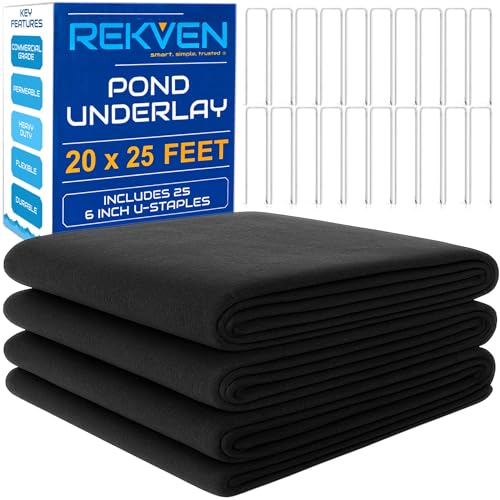
Best for: Large fish ponds, koi ponds, or settings with significant rock or root exposure. This premium non-woven geotextile underlayment acts as a durable barrier between the pond liner and the ground, helping prevent punctures and sagging. It is compatible with EPDM, HDPE, LLDPE, RPE, LDPE, and PVC liners, providing versatile protection for various liner types.
Why chosen: It offers robust protection over a large area, reducing maintenance and extending liner life. The fabric helps distribute weight and stabilize the liner, aiding even water distribution and erosion control.
Limitation: The larger size may require more material handling and cutting for irregular pond shapes.
REKVEN Pond Liner Underlayment — 15 x 20 Feet

Best for: Medium-sized ponds with moderate debris. This underlayment provides a solid barrier to protect liners from rocks, roots, and sharp objects while helping maintain structural integrity and even water distribution.
Why chosen: Its combination of puncture resistance and stability reduces liner wear and minimizes maintenance, supporting long-term pond health.
Limitation: May be less ideal for very large ponds where extra surface area protection is needed.
Beckett Non-Woven Brown Underlayment — 6 ft. x 12 ft.

Best for: Small to medium ponds or tight spaces where precise fitting is needed. This precut underlayment provides an extra layer of protection and helps keep liners from punctures caused by rocks or roots.
Why chosen: Its compact size makes installation straightforward in limited areas, and polypropylene construction adds durability and flexibility.
Limitation: Coverage is limited compared to larger panels, so multiple sheets may be needed for bigger ponds.
Chonway 10 X 15 ft Underlayment — 200g

Best for: Ponds with variable shapes or moderate debris. The 15 x 10 ft sheet can be cut to fit irregular pond footprints and helps prevent punctures from stones and roots.
Why chosen: The thick, cushioning layer supports longer liner life and reduces distribution stresses, which helps maintain pond stability during freeze-thaw cycles.
Limitation: Requires precise cutting to fit unique shapes, and a thinner profile than some larger underlayments.
HZCGJMY Pond Liner Underlayment — 10 x 15 Feet

Best for: Mid-sized ponds or waterscapes with varied terrain. Thick non-woven geotextile fabric provides robust protection and a longer service life for outdoor pond installations.
Why chosen: Includes 20 U-pins and gaskets to secure the fabric, aiding installation and reducing movement that could compromise liner protection.
Limitation: The kit size may necessitate additional pieces for very large ponds or complex layouts.
Buying Guide
- What thickness and density matter? Thicker underlayment generally offers better puncture protection and longer life, especially where sharp stones or roots are present. Look for non-woven geotextile materials with high puncture resistance.
- How large should the underlayment be relative to the pond? Choose sizes that cover the entire pond footprint with extra margin to spare for shaping and cutting. For irregular ponds, prefabricated sheets that can be cut to fit help reduce seams and potential weak points.
- Is compatibility with liner type important? Many underlayments advertise compatibility with EPDM, HDPE, LLDPE, RPE, LDPE, and PVC liners. Confirm compatibility if you already own a specific liner material.
- What about installation and securing? Some products include U-pins or gaskets to anchor the underlayment. Securing the underlayment helps prevent shifting and sagging, which can stress the liner.
- Maintenance considerations? A good underlayment reduces liner wear and makes pond maintenance easier by preserving structural integrity and water distribution over time.
Frequently Asked Questions
- What is pond liner underlayment? A protective fabric placed under the pond liner to shield it from rocks, roots, and sharp objects, while helping distribute weight evenly.
- Do I need underlayment for a small pond? Yes, even small ponds benefit from a cushion that reduces punctures and liner wear in the long term.
- Can underlayment work with any liner type? Most underlayments are designed to be compatible with common liners such as EPDM, HDPE, LLDPE, RPE, LDPE, and PVC, but verify compatibility with your liner.
- How thick should pond underlayment be? Thicker underlayment offers more protection but requires careful cutting and placement to fit shapes; typical options range from mid to thick densities.
- What installation accessories help? U-pins, gaskets, or edge trim can improve stability and reduce movement of the underlayment and liner during backfilling.
- How do I choose between large and small sheets? Large sheets minimize seams and potential weak points, but smaller pieces can be easier to fit around irregular shapes.