Best Tow-Behind Lawn Seeder and Spreader Solutions for Large Yards
Answering the question: which tow-behind seeder or spreader fits your lawn, terrain, and project size? This guide highlights five top options for American buyers, focusing on capacity, spreading width, and aeration features. Ideal users include large-yard owners, DIY lawn-care enthusiasts, and contractors who need efficient, one-pass seeding, fertilizing, or aeration. Below you’ll find a quick product summary, followed by in-depth sections to help you compare and decide.
| Product | Capacity | Spread Width | Best For |
|---|---|---|---|
| Agri-Fab Tow Behind Spiker Seeder | 100 lb | 32 in | Small to medium lawns needing aeration and seeding in one pass |
| Agri-Fab Pull Behind Broadcast Spreader | 130 lb | 12 ft | Medium to large lawns with fewer refills |
| Brinly Tow Behind Combination Aerator Spreader | Weight tray adds depth | 32 in | Aeration plus seeding in a single pass |
| Suchtale Upgrade 40-Inch Tow Behind Spiker Seeder | 100+ lbs hopper | 32 in | Comprehensive aeration and spreading with precise flow |
| VEVOR Tow Behind Lawn Spreader | 100 lb | 32 in | All-terrain spreading and aeration support |
Agri-Fab Tow Behind Spiker Seeder

Capacity and width combine to cover large patches efficiently. The 100 lb hopper with a 32 in working width can cover up to 17,500 sq ft, depending on material and speed. The design supports aeration, seeding, and fertilizer application in one pass, helping you complete seasonal lawn work with fewer passes. The 8 galvanized steel spike disks penetrate the soil for improved seed-to-soil contact and nutrient uptake.
This option is best for homeowners with mid-sized to larger lawns who want to aerate and seed in a single pass, reducing the number of trips across the yard. A potential limitation is refilling on very large areas if you work at a slower pace. Consider this model if you value a combined aeration and seeding workflow.
Agri-Fab Pull Behind Broadcast Spreader

130 lb hopper capacity and a wide 10–12 ft spread width give this spreader power for larger lawn projects with fewer refills. The universal hitch design makes it compatible with most riding mowers and lawn tractors, including major brands. This model aims for consistent, wide coverage to minimize passes.
Best for users with large lawns or properties where fewer refills and steady, even distribution across more ground are priorities. A notable limitation is that very tight corners or irregular terrain may require slow, careful operation to maintain uniformity.
Brinly Tow Behind Combination Aerator Spreader
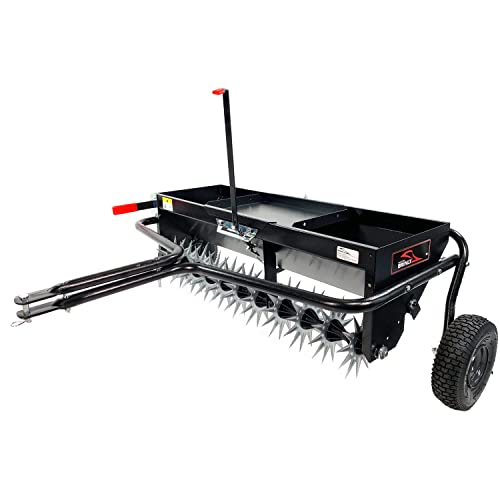
This 2-in-1 design drops seed, fertilizer, or lime while aerating, expediting lawn work and enhancing soil penetration. It includes a weight tray capable of holding up to 75 pounds for deeper soil penetration in tougher areas. The 3-D tines are designed to resist bending and rust, improving longevity in challenging soils.
Choose this if you want a dedicated aeration plus seeding combo in one pass and don’t mind adding weight for deeper penetration. A potential downside is the weight tray requirement for maximum effectiveness, which increases overall weight and handling effort.
Suchtale Upgrade 40-Inch Tow Behind Spiker Seeder

Spike aerator and spreader combo provide even nutrient distribution while aerating. It uses a high-quality steel agitator to prevent clumping, and a 32 inch spread width supports efficient coverage. The nine star-shaped, 3D steel tines offer deep soil penetration with independent rotation to maximize airflow and root access.
Best for users seeking precise flow control and deeper penetration without frequent refills. A limitation is that extreme soil compaction may still require supplemental aeration or adjustments to soil preparation before use.
VEVOR Tow Behind Lawn Spreader
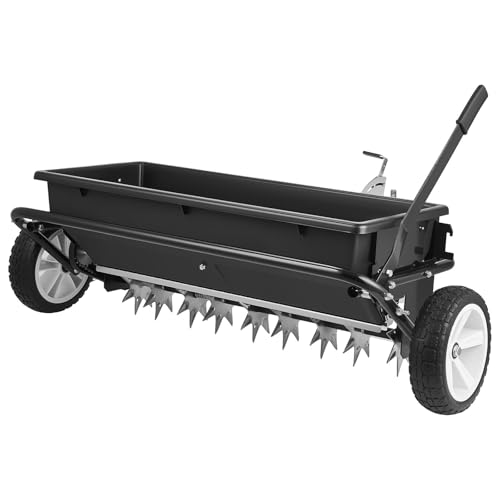
With 72 aeration tines, 32 in spreading width, and 15 settings, this spreader allows precise control for seeds, fertilizer, and ice melt. A durable powder-coated steel frame and hopper resist UV exposure and rust, while 10 inch tires improve traction across lawns, gravel, and snow. The universal hitch supports compatibility with most tractors, ATVs, and UTVs.
Best for customers needing flexible all-terrain performance and a variety of application options. The main caveat is ensuring the ATV/tractor has suitable hitch capacity and that the 32 in width is well-suited to lawn geometry to prevent over-application on edges or slopes.
Buying Guide: Key Considerations For Tow-Behind Lawn Seeders And Spreaders
- Capacity and coverage: How large is your yard, and how often will you refill? Higher hopper capacity reduces refills but adds weight.
- Spread width vs. precision: Wider spreads save time on big lawns but may require careful steering on irregular borders. Look for models with adjustable flow control.
- Aeration vs. spreading: Decide whether you need a dedicated seeder, an aerator, or a 2-in-1 solution. 2-in-1 options save time but may require more setup.
- Hitch compatibility: Confirm compatibility with your riding mower, tractor, ATV, or UTV. Universal hitches help, but confirm payload ratings.
- Durability: Prefer powder-coated or rust-resistant components and heavy-duty tines or disks for tough soils and weather exposure.
- Terrain readiness: If you have uneven lawns, slopes, gravel driveways, or snow, ensure the tires and frame offer stable traction and load distribution.
- Maintenance and refilling: Consider ease of cleaning, clumping resistance, and availability of replacement parts or accessories.
Frequently Asked Questions
- What is the best tow-behind option for large lawns?
– A spreader with a wide spread width (10–12 ft) and high hopper capacity typically reduces refills, such as the 130 lb models with universal hitch compatibility. - Do I need aeration if I’m just spreading seed?
– Aeration improves seed-to-soil contact, so a 2-in-1 aerator-spreader is advantageous when soil compaction is present. - Can I use these on sloped lawns?
– Yes, but choose units with robust construction, good tread tires, and consider weight tray options for deeper penetration on harder soils. - How important is flow control?
– Very important. Infinitely adjustable or clearly marked flow controls help minimize waste and ensure even coverage across diverse lawn areas. - Are there any maintenance tips for longevity?
– Regularly check tines, spray a rust-inhibitor on metal parts, keep the hopper clean, and store in a dry place when not in use. - Which model is best for all-terrain use?
– Spreader models with rugged steel frames, UV-resistant coatings, and large, pneumatic tires tend to perform best across lawns, gravel, and uneven surfaces.