Best Pumps for Irrigation Systems: Reliable Water Delivery for Lawns and Gardens
Choosing the right pump is essential for efficient irrigation. This guide highlights five dependable pumps that steadily move water for lawn sprinklers, drip systems, and garden beds. We compare capacity, voltage, head, and ease of use so you can select the best match for your landscape needs.
The table below summarizes the featured products, focusing on purpose, flow rate, and key strengths to help you compare at a glance.
| Product | Brand | Key Strengths |
|---|---|---|
| GT15 IRRI-Gator Self-Priming Pump | Goulds | Self-priming, fully serviceable, FDA compliant impeller |
| 2 HP Shallow Well Jet/Centrifugal Pump | AQUASTRONG | High flow, durable cast iron, 230V, good suction |
| RL-SPRK200 2 HP Sprinkler Pump | Red Lion | Cast iron housing, thermoplastic impeller, easy priming |
| Weeflos 1.6HP Submersible Pump | Weeflos | Automatic float switch, high flow, corrosion resistant |
| AQUASTRONG 1.6 HP Portable Shallow Well Pump | AQUASTRONG | High head, portability, robust build |
Goulds GT15 IRRI-Gator Self-Priming Pump

The GT15 IRRI-Gator model from Goulds provides a self-priming centrifugal design suitable for irrigation. With a 1.5 hp motor, it delivers reliable flow for lawn sprinklers and drip zones. The unit is designed for serviceability, allowing field maintenance, and features an FDA-compliant impeller to help reduce contamination risk in potable-like water handling. Ideal for systems that experience occasional air pockets, it resumes priming quickly to maintain steady pressure across zones.
AQUASTRONG 2 HP Shallow Well Jet/Centrifugal Pump

This 2 HP pump combines jet and centrifugal stages to deliver strong flow (MAX.Q up to 5200 GPH) and a head up to 108 feet. Built with durable cast iron, it is designed for lawn sprinklers and larger irrigation runs. A 2″ NPT suction and 1-1/2″ NPT discharge support flexible piping. The high-efficiency motor helps maintain performance through multiple zones, making it suitable for medium to large residential setups that require reliable water delivery from wells or storage tanks.
Red Lion RL-SPRK200 2 HP Sprinkler Pump

Red Lion’s RL-SPRK200 offers a rugged cast iron housing with a thermoplastic impeller for reliable water movement in well or lake-water setups. It runs on 230 volts with a PSC capacitor-driven design and thermal protection. Its prime feature is minimal priming after initial fill, reducing startup effort for routine irrigation. Suitable for farms, large home lawns, or properties with water storage tanks, this pump balances durability with straightforward operation.
Weeflos 1.6HP Automatic Booster Pump
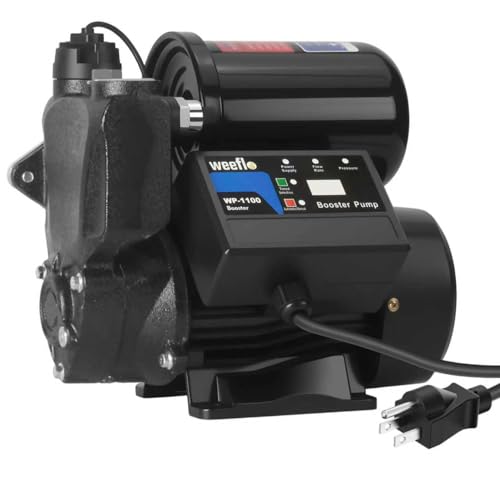
This booster pump emphasizes automatic control with a durable mechanical pressure switch. A 1.5 HP class motor delivers up to 1600 GPH and up to 100 feet of head, making it suitable for boosting domestic water pressure or supporting irrigation lines where existing pressure is insufficient. It is self-priming, easy to deploy, and well-suited for garden and agricultural use where consistent flow and minimal setup are priorities.
AQUASTRONG 1.6 HP Portable Shallow Well Pump

This portable shallow well pump from AQUASTRONG delivers up to 1320 GPH at low head, with a maximum lift of 164 feet. Built from stainless steel and aluminum housing, it resists corrosion and offers robust durability for outdoor irrigation, garden transfer, or sprinkler systems. The unit is designed for portability, allowing quick relocation between zones, with a practical carrying handle and a compact footprint.
Buying Guide: Key Purchase Considerations For Irrigation Pumps
- Flow rate and head: Match GPH and maximum head to the size of your irrigation zone. A higher GPH contracts to larger lawns; head height determines how far water can reach sprinklers and elevated beds.
- Prime method: Self-priming models are easier to start and maintain, especially for setups with air pockets or elevated storage tanks. Submersible pumps excel in wells and basins where the water is readily available at the source.
- Power and voltage: Most residential irrigation pumps use 115V or 230V. Ensure your electrical circuit can safely support the pump’s startup surge and continuous running demand.
- Durability and materials: Cast iron housings and stainless steel components resist corrosion and pressure cycles. For potable or near-potable water, FDA-compliant impellers and food-grade materials add assurance.
- Automation and controls: Mechanical pressure switches offer reliable, straightforward control for drip lines and booster needs. App-controlled kits enable remote scheduling and optimization for smart irrigation.
- Maintenance: Fully serviceable pumps reduce long-term costs. Look for accessible seals, impellers, and diaphragm components for easier field service.
- System compatibility: Check inlet/outlet sizes (NPT), suction depth, and compatibility with drip emitters, sprinklers, or booster lines to ensure smooth integration.
In selecting a pump for irrigation, consider your total dynamic head—combining lift height, friction losses in pipes, and run duration. For well-based systems, choose models designed for prime and lift, with adequate motor protection. For drip systems, emphasize steady low-pressure flow and quiet operation. Finally, factor in seasonal variations, such as drought restrictions or power outages, and opt for pumps with reliable startup and consistent performance across conditions.