Best Puncture-Proof Wheelbarrow Wheels for Flat-Free, Durable Performance
Answering the search intent for buyers seeking puncture-proof, flat-free wheelbarrow wheels, this guide highlights five top options that combine durability, ease of maintenance, and broad compatibility. The selections are suited for: gardeners needing reliable yard carts, contractors handling rough job sites, and DIYers replacing worn wheels on standard wheelbarrows. The following table summarizes the five products and their key traits for quick comparison.
| Product | Size / Fit | Material & Design | Best For |
|---|---|---|---|
| GICOOL 4.00-6 Wheelbarrow Tire | 13″ overall tire, 5/8″ or 3/4″ bearings | ||
| TICONN 4.80/4.00-8 Tire | 14.5″ wheel, fits 13″-16″ ranges | ||
| RONPOW 4.80/4.00-8 Flat Free Tire (2-Pack) | 16″ wheel, 5/8″ & 3/4″ bearings | ||
| MAXXHAUL 13″ No Flat Solid Tire | 13″ tire, 5/8″ axle hole | ||
| AR-PRO 10-Inch Solid Rubber Tire Wheels (2-Pack) | 10″ wheels, 5/8″ bearings |
GICOOL 4.00-6 Wheelbarrow Tire and Wheel

The GICOOL wheel is a 13.5-inch solid tire designed for wheelbarrows and trolleys with 5/8″ or 3/4″ bearings. It is puncture-proof and inflate-free thanks to premium PU foam, offering high wear resistance and tear resistance. This option best fits users who want a straightforward replacement for standard wheelbarrow setups without worrying about air pressure. It is suitable for garden carts and light-duty to mid-duty tasks on job sites. A key limitation is that long-term, high static loading is not recommended, making it better for moving materials rather than fully loaded, stationary hauls.
- Best for: general garden carts, light-to-medium-duty wheelbarrows
- Why selected: reliable flat-free operation with simple installation for common axle sizes
- Caution: not ideal for long-term static loading or highway speeds
TICONN 4.80/4.00-8 Tire
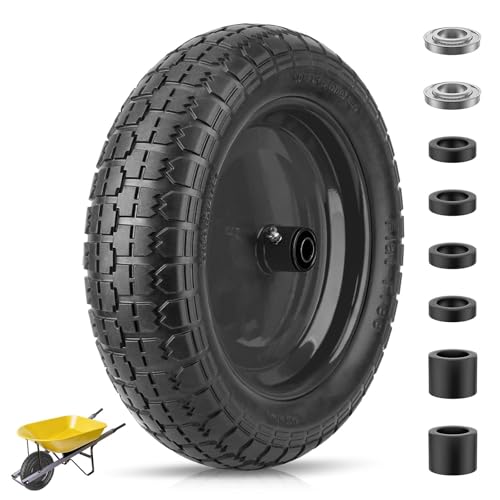
The TICONN wheel uses solid PU foam with steel rims, delivering a rugged, puncture-resistant tire for wheelbarrows, trailers, and garden carts. Its universal fit covers multiple sizes from 13″ to 16″ and several axle standards, making it a flexible option for consumers with mixed equipment. It’s best for projects requiring dependable performance across varied terrains and weather. A potential limitation is temperature sensitivity; prolonged operation above 100°F should be timed to prevent wear or heat buildup.
- Best for: mixed-tool setups across multiple wheel sizes
- Why selected: broad compatibility and durable flat-free construction
- Caution: temperature-related usage limits in extreme heat
RONPOW 4.80/4.00-8 Flat Free Tire Set (2-Pack)

RONPOW’s 4.80/4.00-8 flat-free tire set uses a dense PU foam with both 5/8″ and 3/4″ bearings, designed for a 16″ wheel. It provides puncture-proof reliability across garden, farm, and construction tasks and is marketed as easy to replace, often within about 20 minutes, with no special tools. This product is best for buyers who want to equip multiple tools with a single purchase. A limitation is that the data emphasizes broad usage but does not specify highway speeds or long-distance performance.
- Best for: bulk replacements across several tools
- Why selected: versatility with common bearing sizes and quick DIY installation
- Caution: not marketed for high-speed use or highway conditions
4.00-8 Solid Tire (2-Pack) by Generic

This 4.00-8 solid tire is marketed as a heavy-duty PU wheel with a 5/8″ bushing, designed for direct replacement on standard wheelbarrows and utility carts. It provides a straightforward puncture-proof option without air maintenance and is aimed at users who want a quick upgrade for rough terrain and debris-prone job sites. The listed features emphasize durability and a good fit, though the product copy does not include explicit load ratings or long-term performance data.
- Best for: budget-friendly, direct replacements
- Why selected: simple, no-inflation solution for frequent-use carts
- Caution: check exact axle compatibility before purchase
Buying Guide
What to look for when choosing puncture-proof wheelbarrow wheels
- Size and compatibility: Confirm the tire diameter, width, and axle bore size (5/8″ or 3/4″ are common). Ensure the hub length and mounting pattern align with your wheelbarrow’s axle.
- Material and construction: PU foam solid tires resist punctures and reduce maintenance. Check whether the rim is steel for strength and whether the tread design suits your terrain.
- Load capacity: Look for tires rated to handle your typical load. Many solid tires offer around 300 lbs per wheel, which supports most residential and light commercial tasks.
- Temperature and use-case considerations: Some flat-free tires perform best within certain ambient temperatures. Note any guidance about prolonged use in extreme heat or cold.
- Maintenance and installation: A quick-installation claim (no tools or simple tools) can save time. Consider how easy it is to replace bearings or swap tires across multiple tools.
- Best-use scenarios: Choose based on your primary tasks—garden hauling, construction-site material transport, or heavy-duty cart operations on rough surfaces.
Frequently Asked Questions
- Are puncture-proof tires truly maintenance-free? Yes, most solid PU foam tires do not require air and resist flats, but occasional inspections for cracks or wear are still advised.
- Will these tires fit all wheelbarrows? Not all; check the axle bore size, hub length, and overall diameter to ensure compatibility with your specific model.
- Can I mix different brands on the same cart? Mixing is possible if sizes and axle mounts align, but for best performance, use matched tires on each side.
- Do solid tires perform well on uneven terrain? They generally provide solid stability and reduced sidewall puncture risk, though wheel shock absorption is less than air-filled tires.
- Are flat-free tires good for highway speeds? They are typically designed for yard work and light-duty transport rather than highway travel or high-speed use.
- What is the expected life span of PU solid tires? Durability depends on load, terrain, and maintenance; PU tires often outlast air-filled tires in rough conditions but may wear differently depending on use.