Best Weather Station for Agriculture: Smart Tools for Field Decisions
Farmers and agribusiness stakeholders rely on accurate, local weather data to guide irrigation, planting, and harvest timing. This article highlights top weather stations suited for agricultural settings, emphasizing real-time readings, data accessibility, and ease of integration with farm management systems. Below is a quick summary of five strong options, followed by detailed product sections and a buyer’s guide to help you choose.
| Product | Brand | Key Strengths | Connectivity |
|---|---|---|---|
| Ambient Weather WS-2902 WiFi Smart Weather Station | Ambient Weather | Hyper-local data, comprehensive sensor array | WiFi |
| Ambient Weather WS-2000 Smart Weather Station | Ambient Weather | All-in-one sensor with remote monitoring | WiFi |
| Sainlogic SA6 | Sainlogic | Large color display, robust rain gauge | No WiFi |
| Tempest Weather Station | WeatherFlow | Advanced meteorological sensors, app & Alexa | WiFi (via Tempest ecosystem) |
| Sainlogic SA6 Plus | Sainlogic | AI-driven forecasts, 2-year data storage | WiFi |
Note: All options offer robust data for agricultural decisions, with differences in connectivity, display readability, and data analytics. The selections below focus on five models that balance accuracy, ease of use, and farm-scale applicability.
Ambient Weather WS-2902 WiFi Smart Weather Station
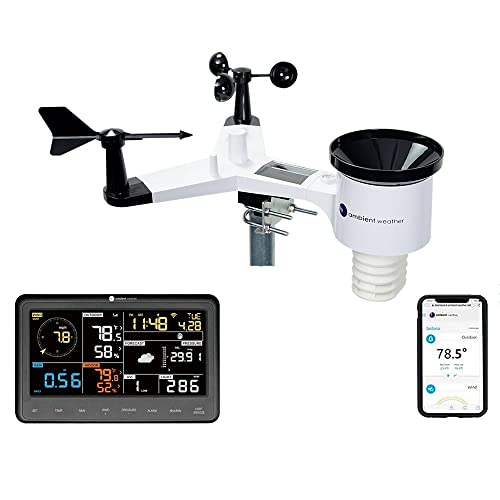
The WS-2902 integrates a complete weather station with an Osprey Sensor Array, a rain gauge, and a color LCD display for easy field viewing. It measures wind speed and direction, temperature, humidity, rainfall, UV index, and solar radiation. Its Wi-Fi capability enables remote access, alerts, and data sharing via IFTTT, Google Home, and Alexa, making it suitable for farm automation and remote farm management systems.
Key advantages include authentic local readings and seamless smart-home integration. For agriculture, remote monitoring helps optimize irrigation schedules and detect unusual weather patterns that could impact crops. Consider the required Wi-Fi coverage and whether you need cloud-based storage or local data logging.
Ambient Weather WS-2000 Smart Weather Station
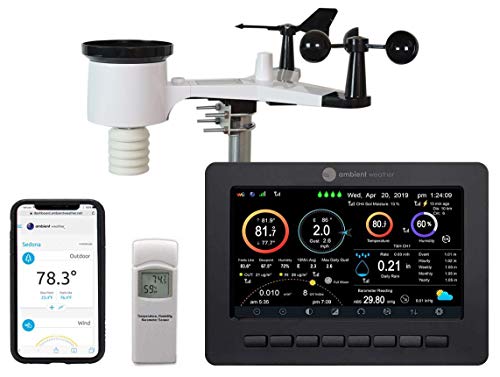
The WS-2000 offers a wireless, all-in-one sensor array with a TFT color display and supports imperial and metric units, along with calibration. It captures wind speed and direction, temperature, humidity, rainfall, UV, and solar radiation. The system is designed for easy remote monitoring and alerts, which is valuable for farm operations requiring timely irrigation and protection from frost conditions.
Farmers may value the clear, color-rich display and flexible units for cross-checking with soil moisture data and irrigation controllers. If you need broader data integration, verify compatibility with your existing farm management software and automation workflows.
Sainlogic SA6 Weather Station
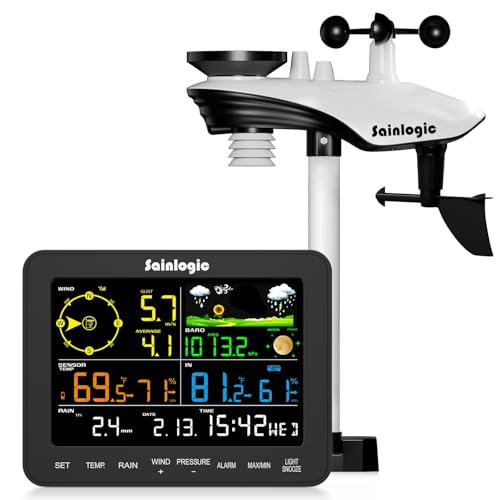
The SA6 features a 6.5-inch HD color LCD with adjustable backlight for readable data in various lighting. Outdoor sensor placement is simplified, and the rain gauge provides precise rainfall monitoring. The system emphasizes straightforward setup and reliable data collection, ideal for growers who want a dependable standalone station without Wi-Fi dependence.
For agricultural use, the SA6’s strong rainfall accuracy and simple installation can support irrigation planning and climate trend analysis on smaller plots or alongside other weather tools. Consider whether you need remote access or local-only operation based on your site’s connectivity.
Tempest Weather Station
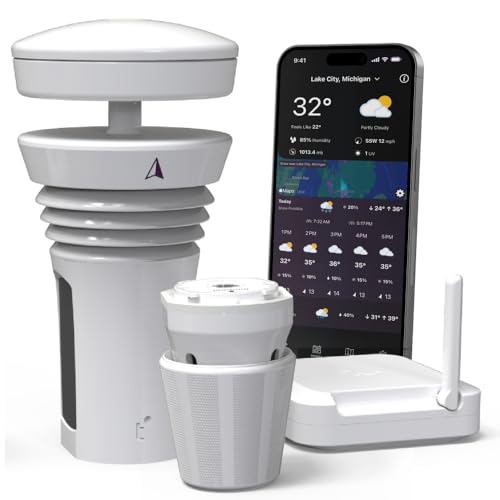
Tempest combines built-in wind measurement, rain gauge, and accurate forecasts with wireless data transmission up to 1,000+ feet. It monitors temperature, humidity, barometric pressure, wind speed and direction, dew point, UV, rainfall, and lightning events, delivering updates every few seconds. The solar-powered outdoor sensor supports reliable field data collection and integration with smart home ecosystems via the Tempest app and Alexa.
In agricultural settings, the Tempest system offers granular, near-real-time data and alerts that support irrigation timing, frost risk assessment, and crop protection decisions, especially in larger properties or areas with variable microclimates.
Sainlogic SA6 Plus Weather Station

The SA6 Plus emphasizes AI-based Weatherseed forecasts and 24/7 alerts, accessible via Wi-Fi. It offers a high-contrast display, easy readability, and a 2-year data storage capability with Excel export support. This model is designed for ongoing trend analysis, long-term planning, and comparative studies—useful for seasonal irrigation planning and field-level climate assessment.
Choosing this option suits farms that want predictive insights and structured data retention. Ensure your network supports consistent 2.4 GHz Wi-Fi connectivity and that data export formats align with your farm analytics workflows.
Buying Guide: Key Purchase Considerations
Choosing the right weather station for agriculture involves balancing data scope, ease of use, and how readings will be applied on the farm. Consider the following factors:
- Data coverage: Look for multi-parameter sensors (temperature, humidity, wind, rainfall, UV, solar radiation) and rainfall accuracy to guide irrigation and crop protection decisions.
- Connectivity: Wi-Fi-enabled models enable remote monitoring and cloud analytics, while non-Wi-Fi options rely on local displays and offline logging. Consider field site connectivity and power sources.
- Display and readability: Large, high-contrast LCDs or color displays improve usability in outdoor and workshop environments, especially for seasonal workers and partners in the field.
- Data access and export: Assess whether the system supports data export (CSV/Excel) for long-term trend analysis, drought planning, and compliance records.
- Alerts and automation: Configurable alerts (e.g., rainfall thresholds, temperature dips) help automate irrigation and frost protection, reducing manual monitoring needs.
- Scalability: If expanding operations, ensure the station can integrate with other sensors or farm management software and offer API access or compatibility with common platforms.
- Power and placement: Outdoor sensors should be properly sheltered, mounted away from heat sources, and calibrated for the micromicroclimates within fields or greenhouses.
- Maintenance: Check sensor durability, calibration needs, and replacement parts availability to minimize downtime during critical growing periods.
- Data privacy and ownership: Clarify where data is stored and who owns cloud data, especially for farm-level analytics and sharing with agronomic consultants.
- Price-to-value balance: Compare total cost of ownership, including sensors, mounting hardware, and potential subscription fees for cloud features.
When selecting, align the weather station with your crop types, irrigation system, and the scale of your operation. For extensive fields, prioritize robust rainfall measurement and wind data to optimize irrigation efficiency and crop protection strategies. For greenhouse environments, emphasis on precise temperature, humidity, and CO2-related metrics can improve climate control. A combination of a reliable local display with cloud-enabled monitoring often provides the best mix of immediacy and long-term insight.