Best Weed Killer Options for Clover Food Plots: Target Weeds, Protect Forages
When you manage clover food plots, select weed killers that target unwanted grasses and broadleaf weeds without harming your clover and other forage plants. This guide reviews five targeted herbicides ideal for deer-friendly plots, focusing on product purpose, best-use scenarios, and practical cautions. Best for plot managers who want precise control, easy application, and compatibility with clover and alfalfa stands.
Summary of selected products:
| Product | Best For | Key Benefit |
|---|---|---|
| Whitetail Institute Arrest Max Selective Grass Control | Grass control in deer food plots | Broad grass suppression with safety for forages |
| Whitetail Institute Slay Selective Broad-Leaf Weed Control | Broadleaf weed control in plots | Effective early-season broadleaf management |
| Butyrac 200 Herbicide (2,4-DB) | Broadleaf weeds in alfalfa or clover surroundings | Targeted broadleaf control |
| Clethodim 2E Herbicide | Grass control | Selective grass control with broad platform |
| Agrisel GrassOut Max (32 oz) | Wide coverage weed suppression | High-volume option for large areas |
Note: Always follow label directions and local regulations. The recommendations below are based on general suitability for clover food plots and typical use cases described in product features.
Whitetail Institute Arrest Max Selective Grass Control
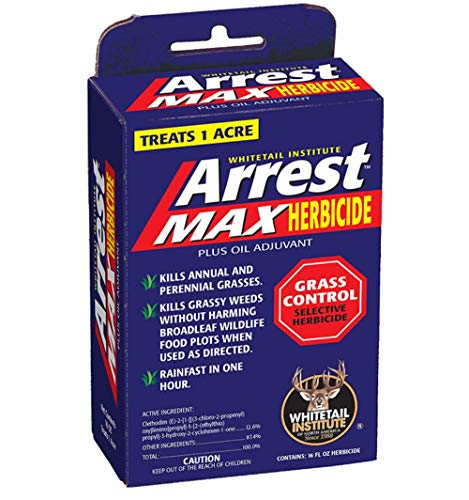
Features: Specifically developed for food plots; Controls a broad range of annual and perennial grasses; Safe for Whitetail Institute perennial forages and with any clover or alfalfa plantings.
Best for: Plot managers who need strong grass suppression in a deer food plot without harming clover or alfalfa stands. This product is chosen for its explicit focus on grass control within forage systems, making it a strong “best for” option when grasses compete with clover.
Limitations: As a grass-specific herbicide, it is not intended for broadleaf weed control. Use alongside a separate broadleaf treatment if needed to address other weed types.
Whitetail Institute Slay Selective Broad-Leaf Weed Control
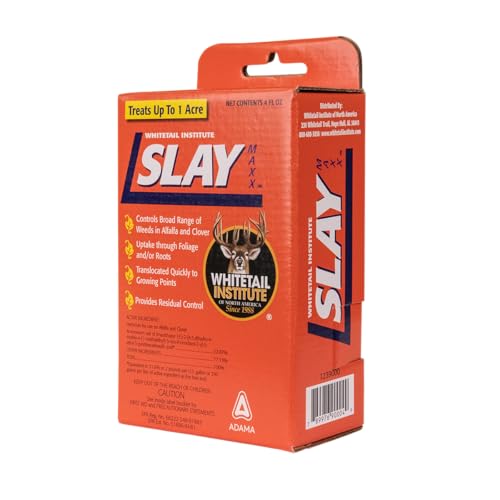
Features: Specifically developed for food plots; Spray spring or early summer when broadleaf weeds are emerging and in early growth; Can be applied with a 4-wheeler or tractor sprayer.
Best for: Users dealing with emerging broadleaf weed pressure during the early growth stage of the plot. Choose this if broadleaf competition is your primary concern and you have gear capable of spray application across the field.
Limitations: Broadleaf-focused; does not address grasses. Pair with a grass-control product if grasses are also present in the plot.
Butyrac 200 Herbicide (2,4-DB)
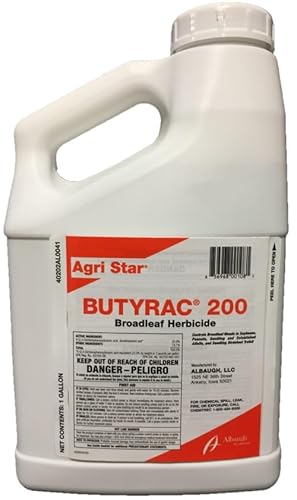
Features: Broadleaf weed control in alfalfa.
Best for: Clover or alfalfa plots bordered by or intercropped with broadleaf weeds. Useful when broadleaf competition is a primary concern around legume crops.
Limitations: Focuses on broadleaf weeds; not a grass-control solution. Use alongside a grass-targeting product if grasses are present in the plot.
Clethodim 2E Herbicide

Features: Grass control.
Best for: Situations where grass encroachment threatens clover stands and you need a reliable grass-selective herbicide. It is a good companion to a broadleaf product when both weed types are present in the plot.
Limitations: Primarily a grass-control product; does not address broadleaf weeds. Consider a second product for broadleaf management if required.
Whitetail Institute Arrest Max (Pack of 4)

Features: Per-pack information; Specifically developed for food plots; Controls a broad range of annual and perennial grasses.
Best for: Plot managers who want multiple applications to cover larger plot areas over time while maintaining grass suppression in deer food plots.
Limitations: Pack-based data may require careful mixing and per-pack usage planning; verify per-pack coverage and rotation needs for your field size.
Buying Guide: Key Considerations for Clover Food Plots
- Weed type focus: Identify whether grasses, broadleaf weeds, or both are the main competition. Use a grass-targeting herbicide (like Arrest Max or Clethodim) for grasses and a broadleaf-specific product (like Slay or Butyrac 200) for broadleaf control.
- Plot composition: If your plots primarily consist of clover with some alfalfa or other forage, select products labeled safe for those forage species. Always confirm compatibility with your specific legume mix.
- Application method: Consider equipment availability (hand sprayer vs. tractor or 4-wheeler sprayer) and timing. Early-season application often yields better control for young weed growth.
- Rotation and compatibility: Rotate herbicides to prevent weed resistance and ensure compatibility with multiple forage stands in your plots. Some products are safer to use repeatedly in legume-dominated plots.
- Safety and cautions: Note any warnings about nearby desirable grasses or flowers. Be mindful of where you apply if you want to protect existing lawns or ornamental plantings near the plot.
- Terrain and scale: For larger plots, high-volume formulations (like Agrisel GrassOut Max) may offer practical coverage, while smaller plots may benefit from targeted sprays with more precise applications.
Frequently Asked Questions
- What is the best option for grass control in clover plots? – Arrest Max provides targeted grass suppression and is designed for food plots that include clover and alfalfa forages.
- Should I treat grasses and broadleaf weeds separately? – Yes. If both weed types are present, use a grass-control product alongside a broadleaf herbicide to cover all weed species.
- Can I use these products on established clover stands? – Many are formulated for use with clover or alfalfa plantings, but always follow the label for age and growth stage restrictions.
- How should I apply herbicides on large plots? – For large areas, consider equipment-friendly formulations and follow recommended mixing ratios to ensure even coverage.
- Are there safety concerns near lawns or ornamentals? – Some products can harm grasses or desirable plants nearby; plan application zones to minimize drift and exposure to non-target species.
- What should I do if weeds recur after treatment? – Reassess weed pressure, timing, and product rotation. Some weeds may require a second, properly timed application using a different mode of action.