Best UV and IR Grow Lights for Indoor Plants and Tents
Answering the question many indoor gardeners ask: which UV and IR enhanced grow lights deliver reliable spectrum for seedlings, vegetative growth, and flowering without wasting energy? This guide highlights five top options, explaining who each is best for and why. Ideal buyers include hobbyists with grow tents, small-scale indoor farms, bonsai enthusiasts, and those seeking higher yields through targeted UV and IR supplementation. The table below shows the five selected products for quick comparison.
| Product | Best For | Key Benefit |
|---|---|---|
| Spider Farmer SUPP-UV60 & IR30 LED Grow Light Bars | Grow tents requiring strong UV/IR supplementation | High-density UV and IR bars for dense planting setups |
| FECiDA Desk Grow Lights | Desktop or table-top setups | Full-spectrum UV-IR with daisy-chain for multiple units |
| Ohtoad Grow Lights (1 Pack) | Hanging installations for flexible layouts | 200W power with UV-IR full spectrum and easy positioning |
| KOSCHEAL KS2000 LED Grow Lights | Larger tents needing scalable coverage | 230W with 2.8 µmol/J and veg/bloom switches including UV/IR |
| VIPARSPECTRA P700 Grow Light | Seedlings and vegetative growth in smaller tents | High PAR, energy-efficient 70W with heat-dissipating design |
Spider Farmer SUPP-UV60 & IR30: Powerful UV/IR Bars for Tents
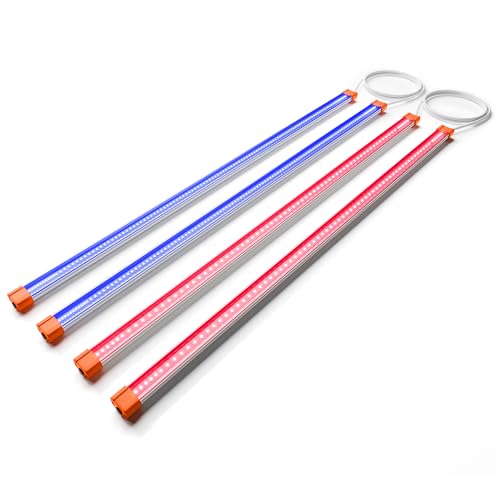
Why use supplemental UV and IR: The unit emphasizes that UV diodes and 730–745 nm IR diodes can meaningfully influence growth when properly scaled to the plant’s stage. This set specifically targets flowering and fruiting with a 365–370 nm UV and 730–745 nm IR spectrum. Best for growers who want visible enhancement in flowering and robust bud formation in tent environments.
High-density LED array: The 35.4-inch bar set contains four bars. Each UV bar houses 120 diodes; each IR bar has 88 diodes, all in sturdy metal casings. This configuration aims to maximize canopy coverage and uniformity across dense plantings.
Best use and caution: Use this kit to supplement main lighting during flowering; avoid running UV throughout an extended entire photoperiod unless plants specifically benefit from it. The data notes the spectrum is optimized for UV/IR supplementation rather than replacing primary lighting.
FECiDA Desk Grow Lights: Compact UV-IR Full Spectrum

UV-IR included full spectrum: This desktop model combines 3000K, 5000K, 660 nm, and UV-IR LEDs with a natural sunlight feel. The 395 nm UV adds a boost to plant health and pigment development, which can support flowering and overall vigor in indoor settings.
Brightness and efficiency: With 2,000 lumens and 25 watts, it is comparable to a 200W incandescent setup but designed for energy efficiency and quiet operation. It is suitable for seedlings, low-height starter plants, and small tabletop gardens.
Daisy chain capability: The desk design includes a daisy-chain function, allowing up to four units to be chained from one outlet. Best for compact setups needing uniform light across several small pots without clutter.
Ohtoad Grow Lights: Flexible Hanging Full Spectrum

Powerful LED array: The Ohtoad lineup uses 204 LEDs including 3000K, 5000K, 660 nm, and UV-IR diodes. It emphasizes flowering with 730 nm IR while UV contributes to plant health and resilience. The unit runs at 200W of light output while drawing about 25 watts, prioritizing energy efficiency.
Versatile installation: Hanging design offers two setup methods—hang above plants or attach to a shelf—making it flexible for different grow spaces. A long 6.6-foot cord supports height adjustments in taller tents or rooms.
Best use and caveat: Choose this if you want a single, adjustable solution for seedling to bloom phases. It includes a daisy chain option, but verify the total number of units you plan to run from a single outlet to manage cord clutter.
KOSCHEAL KS2000: High-Efficiency 230W LED Panel
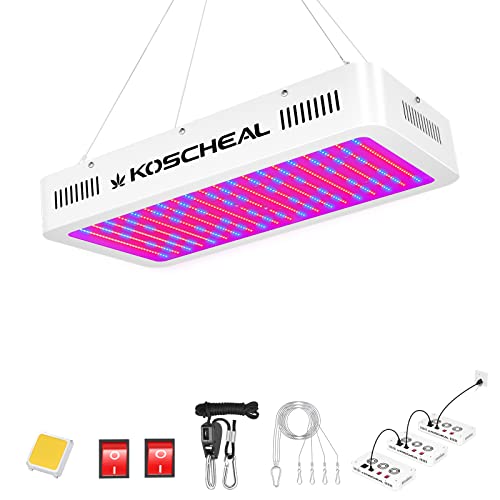
230W high yield with UV/IR: The KS2000 provides 2.8 µmol/J efficacy, replacing traditional 400W HPS/MH setups while keeping energy costs lower. It uses a full spectrum with UV and IR diodes to support vibrant blooms and strong vegetative growth.
Veg and bloom switches: Independent controls offer tailored lighting for different lifecycle stages, enabling precise growth management. UV and IR diodes support anthocyanin development and faster flowering.
Wide coverage and daisy chain: Coverage depth scales with tent size—4×4 ft for vegetative growth and 3.5×3.5 ft for flowering. Up to three units can be linked via the daisy chain, simplifying setup in larger tents.
VIPARSPECTRA P700: Efficient 70W Full Spectrum

Seedling and veg optimized: The unit uses a tailored diode layout with a high-performance driver to deliver 11,000 lumens. It supports vigorous vegetative growth and healthy seedling development for smaller tent setups.
Full spectrum with efficient heat management: A balanced mix of 660 nm red and 3000K/5000K white LEDs mirrors natural sunlight. The fanless, large aluminum heat sinks promote cooling and extend lifespan while keeping noise low.
Energy efficiency and space: At 70W, this light provides strong PAR for a 2×2 ft vegetative area without excessive power draw, making it a practical option for compact grow spaces.
Buying Guide: UV & IR Grow Light Essentials
- What to prioritize: Spectrum customization is key. Look for dedicated UV (around 365–395 nm) and IR (around 730–745 nm) diodes with sufficient intensity and a spectrum that aligns with the plant stage you’re targeting (vegetative vs. flowering).
- Power and efficiency: Higher wattage often translates to greater PAR, but efficiency (µmol/J) matters for energy costs. Compare actual PAR delivery per watt and coverage area for your tent size.
- Coverage and mounting: Consider the tent footprint and height. Some lights are designed for hanging, others for desk use or bar configurations. A daisy chain can simplify multi-light setups.
- Control and flexibility: Veg/bloom switches and timer compatibility help tailor lighting to plant cycles. UV can stress or benefit plants depending on duration and intensity; plan usage accordingly.
- Durability and cooling: Metal housings and robust heat dissipation extend life in long-term use. Noise levels matter if you’re running lights during quiet hours in living spaces.
- Safety and installation: Ensure power cords and connectors are rated for your outlet configuration. For higher-wattage systems, verify electrical load capacity to avoid overloading circuits.
- Compatibility with grow tents: Match light footprint to your tent size and frame to avoid hotspots or shading. Some units provide precise coverage maps or recommended tent sizes.
FAQ
- Can UV and IR light boost plant yields? Yes, when used during appropriate growth stages, UV can enhance pigment and health, while IR can support flowering and stem growth.
- Is a higher wattage always better for UV/IR lights? Not necessarily. PAR efficiency and spectral balance for your plants matter more than raw wattage alone.
- Should I run UV light every day? Generally not; optimize duration and intensity to match the plant’s growth stage to avoid stress or unnecessary energy use.
- What is daisy chaining good for? It simplifies wiring in setups using multiple lights by feeding power through a single outlet, reducing clutter and cords.
- Which light is best for small tents? Compact options like VIPARSPECTRA P700 or FECiDA desk lights are convenient for seedling and veg phases in tight spaces.
- Do all UV/IR lights require fans for cooling? Some models are fanless or rely on passive cooling; check the heat management design if you operate in a quiet space.